

Physical showroom space is the most expensive square meter in retail, and it can only ever display a fraction of what a brand actually sells. A virtual showroom removes both constraints at once.
This guide covers what a virtual showroom is, how it differs from a 360° tour or a product configurator, what it costs, and how to build one — with real examples from three sectors where the format is already producing results: automotive, fashion and furniture.
What Is a Virtual Showroom?
A virtual showroom is a digital environment where customers browse and interact with products in three dimensions, rather than scrolling through flat photography. Products can be rotated, opened, customized, placed at real scale, and in some cases used.
The critical distinction from a product page is agency. On a product page, the customer consumes what you chose to photograph. In a virtual showroom, the customer directs the experience — and every choice they make signals intent.
Virtual Showroom vs 360° Tour vs Configurator
These three get conflated constantly, and the confusion leads to badly scoped projects.
| What it is | Best for | Limitation | |
|---|---|---|---|
| 360° tour | Photographic panorama of a real space, with navigation hotspots | Showing an existing physical location cheaply and quickly | Products cannot be manipulated — it is a photograph you can look around |
| Product configurator | Real-time 3D model of one product with customizable options | Deep customization of a single item | No environment, no range browsing |
| Virtual showroom | Real-time 3D environment containing multiple products | Presenting a full range, brand storytelling, guided selling | Higher production investment |
The strongest implementations combine them. A virtual showroom that contains configurable products gives you range browsing and deep customization in one experience — which is exactly the model the automotive examples below follow.
Where Virtual Showrooms Run
- Web (desktop and mobile) — maximum reach, no download, works from an email link. The volume channel.
- Mobile AR — products placed at real scale in the customer’s own room. Highest realism without hardware.
- VR and mixed reality headsets — the deepest, most emotional version. Best for high-consideration purchases, flagship launches, events and B2B sales meetings.
Most brands begin with web, then add AR or a headset build for flagship moments.
The Business Case for a Virtual Showroom
What Brands Actually Gain
- Range without floor space. Every variant, color, and configuration available simultaneously, in every market, at no incremental cost per item.
- Global reach on day one. A buyer in Riyadh and a buyer in Chicago see the same showroom at the same moment. For B2B sales, this replaces flights, freight, and sample logistics.
- Cost per presentation collapses. Building the showroom is a one-off; showing it to the ten-thousandth customer costs nothing.
- Behavioral data. Which products get opened, which get configured, where sessions end. This is product intelligence a physical showroom structurally cannot produce.
- Speed to market. New collections and models go live in the showroom the day they exist, not when the physical space is rebuilt.
- Sustainability. Fewer sample runs, less freight, fewer showroom builds — increasingly a procurement requirement, not a nice-to-have.
What to Measure
Set these before you build, not after:
- Session duration and depth — how many products viewed per session
- Interaction rate — percentage of visitors who manipulate rather than passively watch
- Configuration or customization completion
- Lead quality — a submitted configuration is a specific, high-intent inquiry
- Assisted conversion — sales where the showroom appeared in the path, not just last click
- Cost per qualified lead, compared against your event and physical showroom baseline
Virtual Car Showrooms
Automotive is the most mature use case, for a straightforward reason: the product is expensive, highly configurable, and impossible to stock in every variant. A dealership can hold a handful of cars. A virtual car showroom holds the entire range in every specification.
It also solves a problem specific to the current market. Electric vehicles are unfamiliar, and the things buyers need to understand — battery placement, cabin architecture, charging, drivetrain layout — are invisible in photography. A 3D environment can open the car up and show them.
Case — Škoda Auto 3D Configurator
Škoda Auto set out to redefine digital car-buying by presenting its newest electric models on Apple Vision Pro. YORD designed and developed the experience end to end.
It combines cinematic vehicle introductions with a fully interactive 3D configurator covering interior and exterior customization. Customers can explore the Škoda Elroq and Epiq in fully immersive VR — or place them life-size in their own space through mixed reality, with real-time vehicle interactions throughout.
Why it works as a showroom: it delivers the two things a physical dealership provides and a website cannot — true sense of scale and material quality — without the customer leaving home.
See the full Škoda Apple Vision Pro project →
Case — Bentley Motors Apple Vision Pro Experience
For Bentley, YORD built a luxury VR journey that combines storytelling, vehicle configuration, and virtual test drives. Customers configure a car in a high-fidelity interactive environment, then drive it through curated international landscapes from home.
The result was a deeper emotional connection to the brand and a genuinely new in-home configuration experience for a customer segment that expects the product to come to them.
Case — Multi-Device Automotive Showroom (Try the Live Demo)
Not every showroom needs a headset. YORD also builds web and app-based virtual showrooms that run on any device — browser, mobile, tablet, and Oculus — so a single build serves both mass-reach web traffic and immersive headset presentation.
Inspired by the metaverse concept, the environment is a high-quality branded 3D space rather than a product grid. Customers move through it, interact with vehicles at interactive points, and can complete a purchase without leaving the experience.
What the build includes:
- 3D high-tech environment with full brand personalization
- Product integration and embedded video, photography, and animation
- Interactive points attached to vehicles and features
- A built-in payment process — this is v-commerce, not a brochure
- Voice communication and live chat, so a sales advisor can guide a customer through the space in real time
- Analytics and heat maps showing exactly where attention goes
Why this model matters commercially: it is the volume tier of the three examples here. The Škoda and Bentley experiences are flagship builds for launches, events and high-value customers. A web-based showroom is the one your entire audience can open from an email link, with no hardware and no download — and it is where the analytics that inform everything else are generated.
Try the live demo → · See the full project →
The lesson across all three: a virtual showroom that only displays is a catalog. The ones that convert wrap the product in narrative — and match the platform to the audience. Web for reach, VR for depth, spatial computing for impact.
For the configurator layer specifically, see our guide to 3D car configurators, costs and examples. For a broader sector view, read how XR and AI are transforming the luxury automotive industry.
Virtual Fashion Showrooms
Fashion has two distinct virtual showroom problems, and they need different solutions.
The B2B problem. Wholesale buying still runs on physical sample collections shipped between showrooms and trade fairs — expensive, slow, wasteful, and limited to those who can travel. A virtual fashion showroom lets buyers view, inspect, and order a full collection remotely, with garments rendered in accurate fabric, drape, and color. Collections go live the moment they are designed rather than when samples arrive.
The consumer problem. Fit and appearance uncertainty drives the return rates that destroy e-commerce margin. Virtual try-on and AR product placement let customers see the item on themselves or in their space before buying.
Case — Fashion Virtual Showroom (Try the Live Demo)
YORD built a fully digital showroom for apparel brands and wholesalers, with a built-in ordering system — a direct answer to the B2B problem above.
Buyers move through a branded 3D environment, inspect garments through interactive points, and place an order inside the experience. It runs on desktop, mobile, tablet, and Oculus, so the same build serves a buyer reviewing a collection on a laptop and one presenting it in a headset at a trade fair.
What it includes:
- 3D high-tech environment with full brand personalization
- Product integration plus embedded video, photography and animation
- Interactive points and an integrated payment and ordering process
- Voice communication and live chat, so a sales rep can walk a buyer through the collection live
- Analytics and heat maps revealing which pieces hold attention
Why it matters: wholesale fashion still runs on physical samples shipped between markets. A showroom with ordering built in removes the freight, the delay, and the travel — and shows the collection the day it is designed rather than the week samples arrive.
Try the live demo → · See the full project →
Case — Sparta AI Mirror, Footballmania
Not strictly a showroom — but it solves the consumer-side problem, and it belongs here.
YORD partnered with Footballmania, ČSOB and Mastercard to launch an AI Try-On Booth at the Sparta Prague Boutique. ČSOB account holders virtually try on football merchandise — the latest Sparta Prague jersey, for instance — through AI-generated images on an in-store interactive screen.
What it includes: AI-generated try-on, an interactive quiz, QR code sharing, and a self-service interface that runs 24/7 without staff involvement.
Why it belongs in a showroom discussion: it is a product showcase that removes the friction of physical try-on while capturing engagement and social sharing. The booth positions the boutique as a retail innovator and turns a merchandise counter into an experience customers photograph and share.
Flagship retail is also one of the best venues for immersive brand activation events.
The pattern across both: in fashion, the showroom and the campaign are increasingly the same asset. One serves the trade buyer remotely; the other serves the consumer in-store. Both replace a physical constraint with a digital experience that generates data.
More on this in our guide to AR clothing and virtual try-ons in fashion retail and our overview of immersive solutions for luxury fashion brands.
Virtual Furniture Showrooms
Furniture has the clearest economics of the three sectors. The products are large, expensive to ship and display, and almost impossible to stock in every fabric and finish. A mid-size sofa range can run to hundreds of valid combinations. No showroom holds them.
A virtual furniture showroom solves four problems at once:
- Every finish, fabric and configuration available to view, with no physical inventory
- Scale confidence — AR placement lets customers see whether the piece actually fits their room, which is the single biggest cause of furniture returns
- Room context — products shown in styled environments rather than on a white background
- Trade and B2B specification — architects, interior designers and contract buyers can review a full catalog remotely
Case — Kitchen and Interiors Virtual Showroom
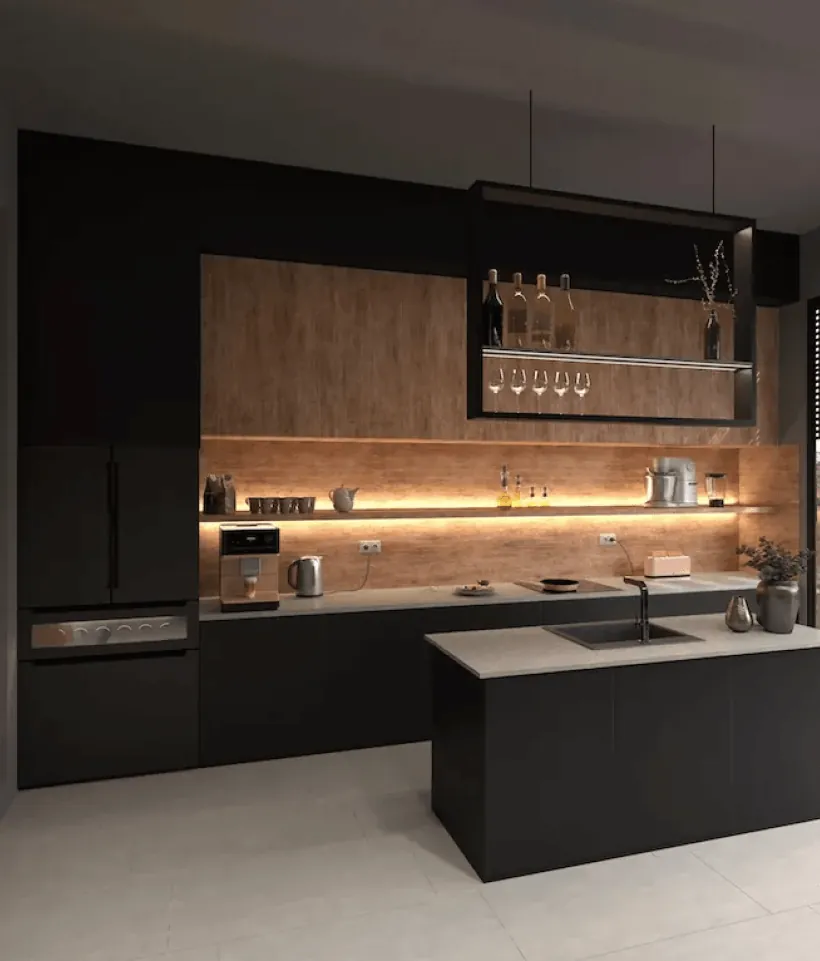
YORD built a virtual showroom helping designers, architects, and electronics brands present their products inside luxury interiors through high-quality 3D imagery.
The approach is to create hyperrealistic 3D models of the home while keeping them fully dynamic — customers interact with products as if standing in a real showroom, from anywhere in the world. An appliance is not shown on a white background; it is shown in the kitchen it was designed for, and the customer can walk up to it.
Why this model works for interiors: the value of a premium appliance or fitting is almost entirely contextual. Isolated on a product page, it is a specification; placed in a designed interior, it is a purchase. The showroom runs on all devices, so the same asset serves e-commerce, trade specification and in-store display.
Virtual Reality Furniture Showrooms in Practice
A virtual reality furniture showroom goes further: the customer walks through a complete furnished space at true scale, rather than viewing individual pieces. For high-value interiors, kitchens and contract projects, this is the closest digital equivalent to standing in the room.
YORD built exactly this for itself. Yord Space is an exact virtual replica of our Prague offices — meeting rooms, workspace, kitchen, staircase and terrace — accessible through a VR headset or the web, with interactive elements, presentations and audio built in.
It began as a response to the pandemic, but the principle generalizes: any physical space can be recreated virtually, then customized and enhanced beyond what the real building allows. For a furniture or interiors brand, that means a flagship showroom that exists in every market at once can be reconfigured for a new collection overnight, and never closes.
Related reading: the role of virtual design tools in architecture.
How to Create a Virtual Showroom
Step 1 — Define Scope and Objective
Reach, conversion, or impact — choose the primary one. A showroom built to generate dealer leads at volume is a different product from one built to headline a trade fair. Trying to serve both in a single build is the most common reason these projects overrun.
Decide up front: how many products, which markets and languages, which audience (consumer, trade, or both).
Step 2 — Audit and Produce 3D Assets
This is the largest workstream in almost every project. Establish what 3D data already exists and what condition it is in. Manufacturing CAD is engineering data, not real-time data — it has to be optimized and rebuilt to render at high frame rates without losing accuracy.
Where no 3D exists, products are modeled from reference or photogrammetry. Budget accordingly.
Materials decide credibility. Paint, chrome, glass, leather, textile weave and wood grain are what separate “a 3D model” from “the product”. Do not under-invest here.
Step 3 — Choose the Platform
Match format to objective:
| Objective | Platform |
|---|---|
| Volume, top-of-funnel, SEO value | Web 3D, mobile-first |
| Scale confidence in the customer’s own space | Mobile AR |
| Flagship launch, trade fair, high-value B2B | VR or spatial computing |
| B2B wholesale collection review | Web 3D with account access and ordering |
Step 4 — Build, Integrate and Test
The build is more than the environment. Plan for product and pricing data integration, CRM and lead handover, analytics instrumentation, and localization. Test on the actual devices your audience uses — a showroom that only performs on a high-end desktop has failed.
Step 5 — Launch, Measure and Iterate
A virtual showroom is a product, not a campaign. Ranges change, collections drop, models refresh. Plan for content updates and post-launch support from the start, or the showroom is out of date within two seasons.
What a Virtual Showroom Costs
Cost is driven by six variables:
| Driver | Lower cost | Higher cost |
|---|---|---|
| Number of products | A focused hero selection | Full catalogue |
| 3D asset readiness | Usable existing models | Everything modeled from scratch |
| Visual fidelity | Good real-time quality | Photorealistic, marketing-grade |
| Environment | Simple neutral space | Bespoke branded architecture |
| Platforms | Web only | Web + AR + headset |
| Integrations | Standalone showcase | Live pricing, stock, CRM, ordering |
For a related breakdown, see augmented reality app costs, challenges and opportunities.
Frequently Asked Questions
What is a virtual showroom? A virtual showroom is an interactive 3D space where customers explore, customize, and experience products remotely. It runs in a web browser, in augmented reality on a phone, or in a virtual reality headset, and allows brands to present a full product range without physical floor space.
How is a virtual showroom different from a 360° tour? A 360° tour is a photographic panorama of a real space that visitors navigate but cannot interact with. A virtual showroom is a real-time 3D environment where products can be rotated, opened, customized, and placed at scale. The tour shows a space; the showroom shows products you can use.
How much does a virtual showroom cost? Cost depends on the number of products, whether usable 3D assets already exist, the visual fidelity required, how many platforms you deploy to, and what systems it integrates with. A focused web-based showroom sits at the entry point; a multi-platform showroom with live pricing and ordering sits at the top.
How long does it take to create a virtual showroom? A focused web showroom with a limited product selection takes weeks. A full multi-platform build with a large catalog and live integrations runs across several months. Availability and quality of existing 3D assets are the largest variable.
Do customers need a VR headset to use a virtual showroom? No. Most virtual showrooms run in a standard web browser on desktop and mobile, with no download or hardware required. VR and mixed reality headsets are used for premium experiences such as flagship launches, trade fairs and high-value client presentations.
Which industries benefit most from virtual showrooms? Any sector where products are expensive, highly configurable, or costly to display physically. Automotive, fashion, furniture and interiors see the strongest results, followed by industrial equipment, real estate and luxury goods.
Can a virtual showroom integrate with our e-commerce or CRM system? Yes. Virtual showrooms can connect to product catalogs, live pricing and stock data, CRM systems and ordering platforms, so a customer’s configuration can pass directly to sales as a qualified lead or order.
Build Your Virtual Showroom with YORD
YORD is an award-winning creative tech studio building next-generation AI and XR experiences, trusted by 200+ global brands including Apple, Meta, LEGO, Bentley, Škoda and L’Oréal. We are a Top 1 VR/AR Global Company on Clutch, a Deloitte Company to Watch, and an XR Awards winner.
We deliver end-to-end — strategy, 3D production, development, deployment and long-term support — across Europe, North America and the Middle East.
Planning a virtual showroom? Get a free consultation, and we will assess your 3D asset readiness, recommend a platform, and give you a realistic timeline.
Explore more: All AI and XR case studies · XR and AI for the automotive industry