
Before comparing numbers, one distinction matters more than any other: the figures below cover the interactive layer — the software, content, hardware and on-site delivery — not the raw stand space itself. Space is a separate line item, and at a major European show it isn’t small. ISE 2027 lists space-only rates of roughly €465–€535 per square meter. A standard 36 m² stand runs close to €18,000–€19,000 for bare floor alone, before a single screen goes up. With that separation in mind, let’s see what the interactive layer itself tends to cost.
How much does an interactive event installation cost?
Interactive event installations typically cost between €8,000 and €90,000+, depending on format, scale and whether the build is reused. An AI photo booth or AR configurator sits at the lower end; a multi-meter LED wall or a multi-headset VR fleet sits at the higher end. The single biggest driver of total cost isn’t the technology — it’s whether you build once or build modular.
| Solution | Indicative range (EUR) | What’s included at that range | Typical lead time |
|---|---|---|---|
| AI Photo Booth | €8,000 – €18,000 | Branded AI-generated photo experience, camera and printer hardware, one campaign “look,” on-site operator, lead-capture integration (QR/email) | 3–5 weeks |
| Motion-Tracked Game | €15,000 – €35,000 | Custom game build on one theme, camera tracking, screen or projection hardware coordination, leaderboard, on-site technical support | 4–8 weeks |
| Interactive LED Wall | €25,000 – €70,000+ | Camera-tracked wall, single screen up to multi-metre format, custom visual world, scenography, on-site crew | 6–10 weeks |
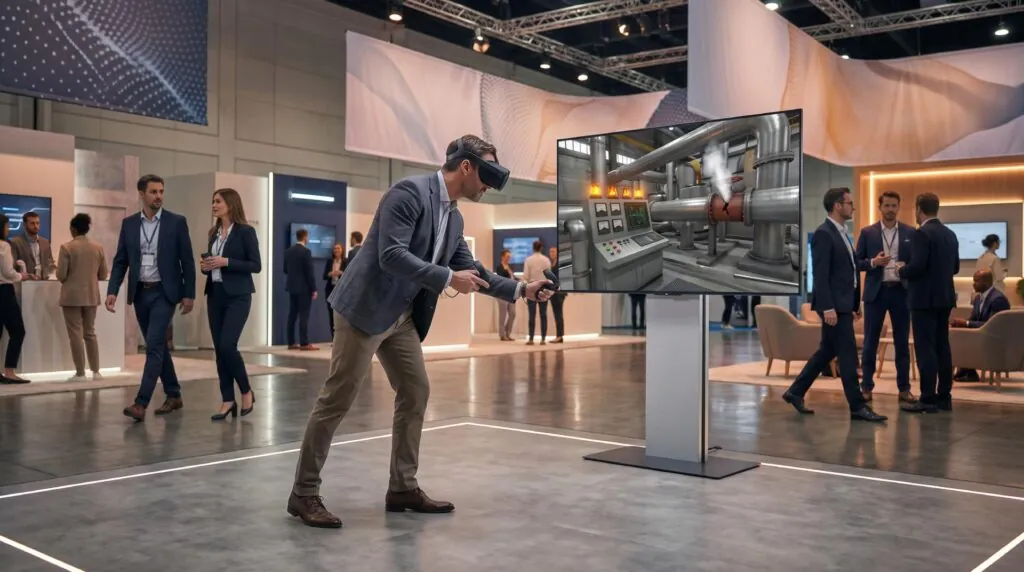
| VR Installation (Location-Based VR, Storytelling VR, VR Game or VR Product Visualization) | €20,000 – €90,000+ | Headset rig (4–8 units typical), content production — captured, scanned or CG — facilitator training, session software. Price varies sharply with content complexity and headset count | 8–14 weeks |
| AR Configurator | €18,000 – €45,000 | Browser or app-based configurator, 3D/CAD asset integration, AR placement layer, lead capture | 6–10 weeks |
| AI Concierge | €30,000 – €80,000 | Avatar or abstract installation, conversational AI trained on a defined knowledge base, multilingual support, on-site hardware | 8–12 weeks |
Before committing to a budget, most teams benefit from first deciding which format actually fits their objective. If you haven’t already, see our guide to choosing the right interactive installation for your exhibit — it walks through the objective-to-format match before you ever get a quote.
For a sense of what the top of that LED wall range buys, ŠKODA EPIQ at Milan Design Week ran an 8-meter browser-based wall that drew close to 60,000 visitors across six days — no app required.
These are indicative ranges reflecting YORD’s positioning as a full-service provider — not fixed quotes. Every one of these formats, along with the seven others in YORD’s interactive installation services, scales up or down from these bands depending on the specifics below.
What are the main cost drivers for an interactive installation?
Seven variables move the number more than anything else:
- Scale and physical footprint. A single-screen photo booth and an 8-meter LED wall are not the same order of spend. Physical footprint also drives shipping, power requirements and on-site crew size. Exhibit space itself already accounts for 40.5% of what a typical exhibitor spends directly on a show, per CEIR’s 2026 exhibitor spending research — the interactive layer sits on top of that baseline, not instead of it.
- Custom vs. modular software. A one-off build written for a single stand costs less upfront than a modular system designed to adapt to different footprints — but the modular system pays for itself from the second event onward.
- Hardware ownership vs. rental. Owning headsets, cameras and printers costs more per event initially but removes rental fees and availability risk from every event after the first.
- Volume and complexity of content. A single campaign “look” for a photo booth costs a fraction of a fully scanned, narrated VR experience with original footage.
- On-site staffing days. Facilitated formats — VR, AI Concierge, any headset-based experience — need trained staff for the full run of the event. Self-service formats like AR-on-phone or an LED wall do not.
- Data capture and lead integration. Connecting an installation to a CRM, capturing opted-in emails and producing a clean export adds development time that a “photo only, no data” version skips.
- Number of venues. A one-off build and a build designed to travel to four or five events in a year carry very different total costs of ownership, covered in detail below.
Rent, build once, or build modular — what is the real cost?
This is the question that actually determines your total spend for the year, not just for one event.
| Approach | What you pay upfront | What happens at event 2, 3 and 4 | Best for |
|---|---|---|---|
| Rent | Lower upfront cost, per-event rental fee | Pay close to full price again each time, subject to availability | A single test event, or a genuinely different format each time |
| Build once (scenography-locked) | Full design and build cost, tailored to one stand or venue | A partial or full rebuild is needed to fit a different footprint | A flagship, one-off activation — a product launch or an anniversary event |
| Build modular | Full design and build cost, engineered to adapt | Only the physical footprint and shipping change. Software, content and interaction logic stay fixed — cost per event drops sharply from event two onward | Any brand exhibiting at more than two events a year |
The math favors modular quickly. A build amortized across four to six events in a year carries a substantially lower per-event cost than either a rental chain or a one-off build repeated from scratch. This is YORD’s core positioning — and it’s the CFO-facing version of a conversation event teams usually have to make on instinct. For more on matching a format to your specific objective before you commit to a build approach, see how to choose the right installation for your objective.
What actually gets cut when the budget is tight — and what should never be cut
Safe to reduce: content complexity (fewer variants, a shorter narrative arc), custom scenography (a modular shell instead of a bespoke structure), and the number of content variants per audience segment.
Never cut: software QA time, on-site technical support, and lead capture integration. A photo booth that crashes on day two of a four-day show, or a VR rig with no facilitator on hand when a headset needs resetting, costs more in lost sessions than the QA time it would have taken to prevent it. And an installation with no lead capture built in is an expensive photo opportunity, not a pipeline asset.
A real example, costed by component: Bobcat at BAUMA
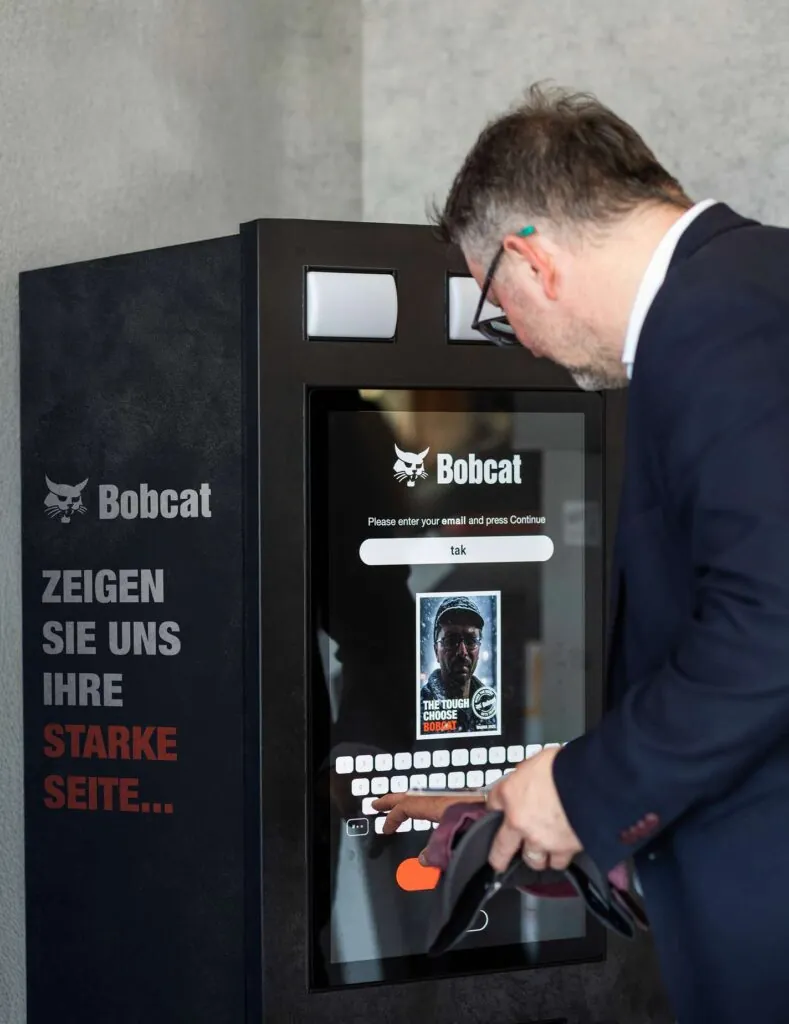
The clearest way to see where an interactive budget goes is to walk through one real build.
The AI photobooth at BAUMA for Bobcat combined a creative concept matched to the brand’s rugged identity, an AI image-generation system tuned to produce dust, mud, ice and rain effects on demand, camera and printer hardware, on-site facilitation across the full run of the show, printed materials, and lead-capture integration through QR codes and email.
What it produced: 1,982 sessions, 947 prints, 453 digital downloads, and 850 qualified email leads.
That last number is worth sitting with. A long-standing CEIR benchmark on exhibition economics put the cost of an initial face-to-face prospect meeting at roughly $96 when sourced from an exhibition lead, against roughly $1,039 when sourced without one — including prospecting and the initial sales call. The figure is old and the methodology isn’t public, so treat it as a directional benchmark rather than a current market average. But it points at the right question: when a traditional badge scan or a cold outbound sequence costs a multiple of that per qualified contact, what does 850 already-opted-in email addresses, collected at a single stand, actually represent?
How far in advance do I need to brief an interactive installation?
| Scenario | Brief | Concept | Build | Deployment | Total lead time |
|---|---|---|---|---|---|
| Standard | Week 1 | Weeks 2–3 | Weeks 4–9 | Week 10+ | 2–3 months |
| Fast-track | Week 1 | Week 2 | Weeks 3–4 | Week 5 | Under 1 month — possible, costs more, leaves no room for iteration |
| Modular reuse | Week 1 | Not needed — existing content | Weeks 2–3 (footprint adaptation) | Week 4 | 2–4 weeks |
The calendar makes this concrete rather than abstract. ISE 2027 opens 2 February at Fira Barcelona Gran Via. The most recent edition, ISE 2026, drew 92,170 visitors and 1,751 exhibitors across 101,000 m² of floor space — the largest total show floor in the event’s history. A brief that lands in October or November 2026 fits the standard timeline comfortably. A brief that lands after early December is fast-track territory, with the trade-offs that implies. The same discipline applies to the shows that follow in quick succession — LEAP in Riyadh and MWC Barcelona both run within weeks of ISE, which is exactly the kind of stretch a modular build is designed to absorb.
Can the same installation be reused at multiple events?
Yes — if it’s built modularly from the start. The distinction is between a scenography-locked build, designed for one venue and one footprint, and a modular build, where the software, interaction logic and content system stay fixed while the physical form adapts to whatever space is available.
The LEGO F1 interactive screen experience is the clearest proof of this at scale: the same core build ran across five cities in five countries without being rebuilt from zero each time. We also created new experiences for the same hardware as part of seasonal campaigns like Halloween, Christmas, Valentine’s and Lego Friends. That’s the difference between paying full price several times and paying only adaptation costs when including a new experience. It’s also the exact question a modular photo booth or AR configurator answers well — and the exact question a bespoke, single-venue LED wall answers poorly.
Frequently asked questions
What is included in the cost of an interactive installation?
Concept and creative development, software or app development, content production, hardware (owned or rented), on-site deployment and technical support, and — where relevant — lead-capture integration with your CRM.
Do I need to own the hardware or can I rent it?
Either works. Renting lowers the upfront cost for a single event; owning pays off from the second or third event onward, particularly for headsets, cameras and printers used repeatedly.
How much does it cost to run an interactive installation for a second event?
For a modular build, substantially less than the first — typically the cost of footprint adaptation and shipping, not a full rebuild. For a scenography-locked build, expect close to the original cost again.
What is the minimum budget for an interactive stand activation?
A single-station AI photo booth is the lowest-cost entry point in this category, typically starting around €8,000 for a short event run.
Can I see examples of interactive installations at trade shows?
Yes — YORD’s interactive experiences case studies page includes delivered projects at BAUMA, HITEX, Milan Design Week and Mobile World Congress, among others.
How long does it take to set up an interactive installation on site?
This depends on format and scale, and is typically confirmed during the briefing stage alongside stand size and venue access windows.
Do you provide on-site support during the event?
Facilitated formats — VR, AI Concierge, any headset-based experience — are staffed for the full run of the event. Self-service formats like AR-on-phone are monitored remotely with on-call support.
What data can an interactive installation capture about visitors?
Depending on the format and what’s agreed at the briefing stage: opted-in email addresses, session counts, engagement duration, and — for formats with a configurator or quiz element — specific product or content interest.
Why YORD for Your Interactive Installation
YORD has delivered over 200 interactive installations for 150+ global brands — from Bobcat to LEGO, Škoda to Bentley Motors — and is recognized as a Clutch Top VR/AR Global Company and Deloitte “Company to Watch” (477% growth). But what matters more than the awards is what they produce: 1,982 photo booth sessions, 850 opted-in leads, and a 1-in-4 engagement rate on brand avatars — the kind of numbers that show up in your pipeline, not just in your event report.
The Bobcat BAUMA example that runs through this guide isn’t a lucky one-off. It’s the standard: a modular build that travels to the next event, runs again with 95% of the original cost already sunk, and captures just as many leads. That’s the difference between paying for innovation and investing in a scalable asset. YORD designs every installation from day one assuming you’ll want to run it again — because the ones that work always do.
What also sets YORD apart: end-to-end delivery across strategy, design, build, deployment, and on-site support. No handoffs to third-party equipment rental companies. No promises that fall apart when a headset needs troubleshooting at 11 a.m. on day two. A dedicated on-site team for the run of your event, embedded into your stand and aligned with your lead and engagement targets.
Ready to see what a modular interactive installation can do for your 2027 event?
Get in touch with us through the form below. Our team will set up a free consultation call, then send you a tailored proposal for your event, space, and date.
YORD’s partners often come by referral and repeat work, and they’re worth talking to early. The earlier you brief an interactive partner, the more time you have to iterate and the better the final result.
See YORD’s delivered interactive installations across ISE, MWC, BAUMA, Milan Design Week and beyond.