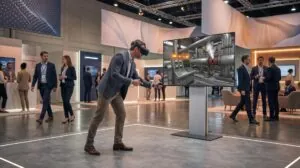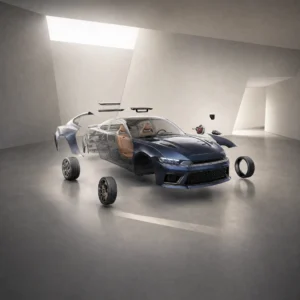
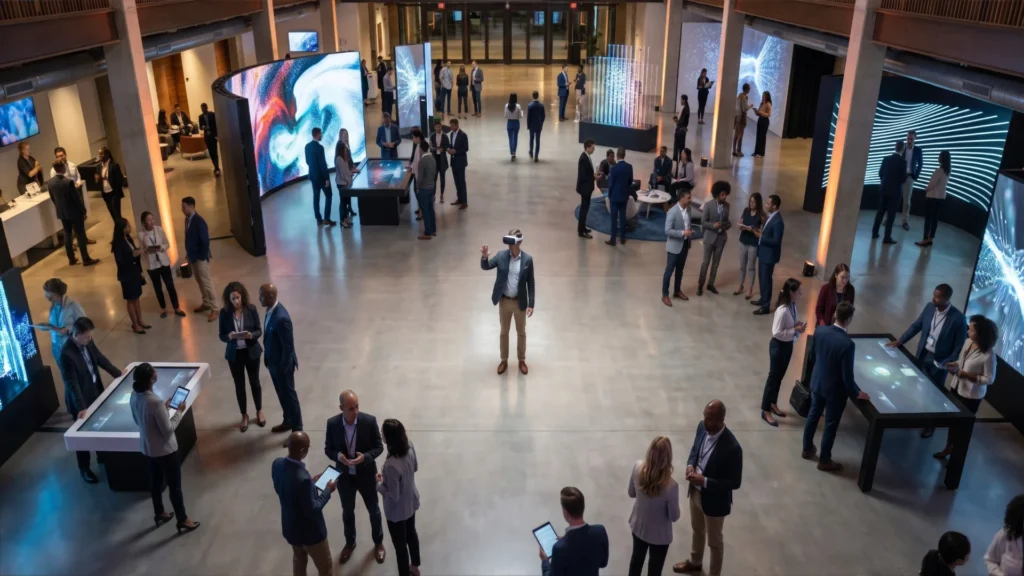

Interactive formats cover almost every exhibit objective, from lead capture to product education. The right starting point is never the technology — it’s the outcome you need. Match your objective to the table below before you compare vendors, and the shortlist narrows itself.
What is interactive event technology?
Interactive event technology is any installation whose output changes based on what a specific visitor does — not what everyone in the room does, and not a fixed sequence playing on a loop. A camera-tracked wall that turns a visitor’s movement into a trail of particles is interactive; a screen playing a product video on repeat is not. An AI photo booth that generates a unique image from that visitor’s pose is interactive; a static branded backdrop is not.
The distinction matters because it’s the difference between a display and an experience. A passive screen informs a crowd. An interactive installation responds to an individual — and that response is what gets remembered, photographed, and shared after the event ends.
Which type of interactive installation is right for my exhibit objective?
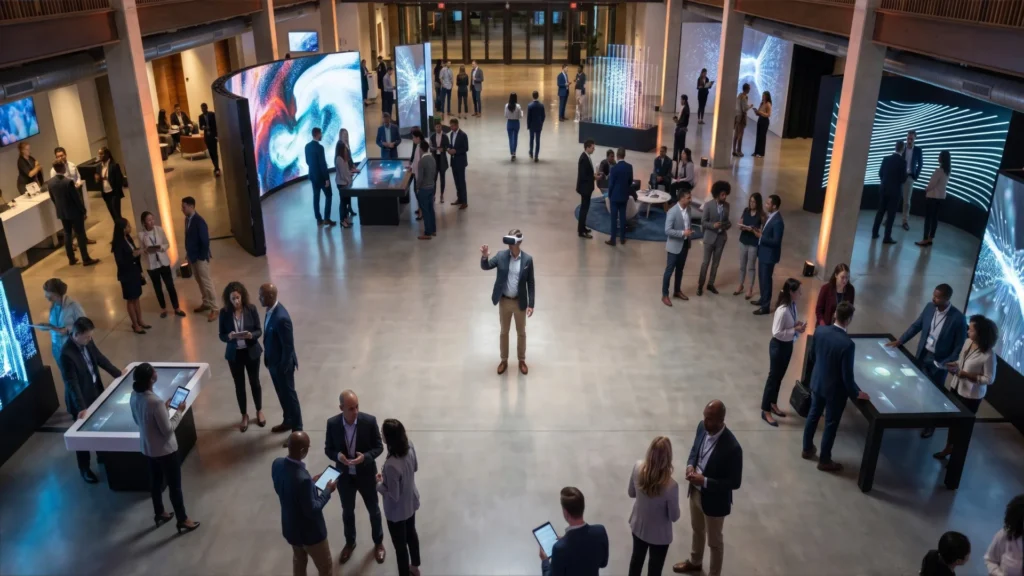
Start with what you want the visitor to do, feel, or know — not with a format you’ve already heard about. The table below maps eight common exhibit objectives to the formats that actually deliver them, with the proof behind each recommendation.
| Your exhibit objective | Best format | Why | What to avoid | Proof |
|---|---|---|---|---|
| Capture qualified leads at a busy show | AI Photo Booth | Every visitor leaves with a personalized branded image and an opted-in email address. Lead capture is built into the experience, not bolted on afterward | Passive displays — nobody hands over contact details to watch a video | AI photobooth at BAUMA, Bobcat 2025: 850 opted-in email leads from 1,982 sessions |
| Stop foot traffic and create a crowd | Interactive LED Wall or Motion-Tracked Game | Visible activity at a distance draws people in. A leaderboard drives repeat attempts. No hardware per visitor, no queue management needed | VR headsets as the primary crowd-draw — headsets create a queue, not a crowd | LEGO F1 interactive experience: 5 cities, 5 countries, one build; ŠKODA EPIQ at Milan Design Week: ~60,000 visitors, 8-meter LED |
| Explain a complex or physically large product | VR Product Visualization | Visitors walk around the product at true scale, look inside it, configure variants — without the product being in the room | A photo booth — it doesn’t convey product information | Korek Telecom VR at HITEX: 768 VR sessions in 4 days |
| Tell a company or brand story with impact | Storytelling VR or Location-Based VR | Places the viewer inside the story rather than presenting it to them. Harder to ignore than a film on a screen | Motion-tracked games — these engage, they don’t inform | Holocaust Educational Trust: 68 headsets synchronized simultaneously |
| Generate earned social reach | AI Photo Booth | Visitors share branded, personalized images. The content travels outside the event hall | Static displays — nobody photographs a brochure stand | ŠKODA EPIQ: 3× higher social engagement from visitor-created content |
| Convert visitors on-site during a short dwell time | AR Product Configurator | Visitor configures their exact specification and sees it at full scale in AR. Decision-making happens at the stand | Storytelling VR — dwell time is too long for a high-volume conversion context | Škoda Enyaq RS configurator: place the car in your own driveway via browser AR, no app |
| Run a large venue or pavilion with dead zones | Location-Based AR Game | Uses visitors’ own phones. No hardware cost per visitor. The game draws people into the whole space, not just the centerpiece | Any format requiring hardware per visitor at scale | Dvořák Monument AR: location-aware experience across a whole park |
| Staff a busy stand or answer repetitive questions | AI Concierge | Works without a human operator. Consistent message to every visitor, in multiple languages | Passive kiosks — nobody engages with a touchscreen menu at a trade show | ŠKODA Metahuman: 1 in 4 visitors at Škoda Museum stopped and engaged |
The most common mistake in this category is starting with a format instead of an exhibit objective — briefing a partner for “a VR experience” rather than for “500 qualified email leads.” Technology chosen backward from a format someone saw at a competitor’s stand often fails to achieve the actual business goal, because the format and the exhibit objective were never checked against each other. Use the table above the other way round: pick the row that matches what you need, then evaluate formats against it.
What is the difference between a VR experience and a motion-tracked game at a trade show?
This is one of the highest-traffic comparison questions in the category, and the honest answer is that both work — for different jobs.
VR requires a headset per visitor. That creates a queue, limits throughput, and needs a facilitator running the session. In exchange, it delivers far higher dwell time and stronger recall than almost any other format.
A motion-tracked game requires no hardware per visitor. There’s no queue bottleneck, it’s visible from a distance, it draws a crowd on its own, and it has lower per-visitor dwell time than VR.
[Suggested in-body image: a real photo from the LEGO F1 interactive screen experience project. Alt text: “Motion-tracked interactive game on a large screen at a LEGO Formula 1 event activation.” Caption: “Body movement steers the on-screen car — no headset, no queue, visible from across the hall.”]
The right choice depends on three things: how many visitors you need to reach per hour, whether crowd-draw or depth of experience is the priority, and whether you have facilitation budget for a staffed format.
| Format | Visitors per hour | Facilitator required? | Visible from distance? | Dwell time (typical) | Lead capture possible? |
|---|---|---|---|---|---|
| AI Photo Booth | 15–25 per station | Recommended | No | 1–3 minutes | Yes — built in |
| Motion-Tracked Game | 20–40 | No | Yes | 2–5 minutes | Yes — via leaderboard sign-up |
| Interactive LED Wall | Effectively unlimited | No | Yes | 1–4 minutes (audience-based) | Limited without a secondary mechanism |
| VR (headset) | 4–8 per headset | Yes | No | 5–15 minutes | Yes — via facilitator or post-session prompt |
| AR on own phone | Scales with footfall, no ceiling | No | No | 2–6 minutes | Yes — via QR/app flow |
| AI Concierge | 10–20 conversations | Optional | No | 2–5 minutes | Yes — via conversation capture |
How many visitors per hour can an interactive installation handle?
This is a question almost nobody publishes a specific answer to — which is exactly why the ranges above are worth bookmarking.
- AI Photo Booth: 15–25 sessions per hour per station. Higher with a one-minute experience, lower with a longer AI generation time.
- Motion-Tracked Game: 20–40 players per hour. No queue in the traditional sense — people self-select in and out.
- Interactive LED Wall: effectively unlimited. It’s audience-based, not session-based, so there’s no queue to manage.
- VR (headset): 4–8 sessions per hour per headset. A six-headset rig serves roughly 35–45 visitors per hour.
- AI Concierge: 10–20 conversations per hour, depending on question depth.
- AR on own phone: scales with footfall — there’s no hardware ceiling at all.
Throughput isn’t just an operational detail — it drives staffing budget, which drives total cost. For the full cost breakdown by format, see how much an interactive installation costs.
What do I need to brief an agency before asking for a quote?
A clear brief is the single biggest lever on both your quote turnaround and your final price. At minimum, an interactive installation services partner needs:
- The event — name, dates, venue, stand size or space available
- The objective — what do you want the visitor to do, feel or know?
- The audience — approximate visitor profile: industry, seniority, B2B or consumer
- Throughput expectation — how many visitors per day, how long should each session be?
- Existing assets — do you have 3D models, product photography, brand guidelines, existing AR/VR content?
- Data capture requirements — do you want to capture leads? If so, how — email, QR, badge scan?
- Reuse expectations — is this a one-off, or will the installation travel to other events?
- Budget band — even a rough range saves two rounds of back-and-forth
The clearer the brief, the faster the quote and the more accurate the timeline. A partner that quotes without this information is guessing.
What should I look for when choosing an interactive technology partner for your exhibit?
Six criteria, written from the buyer’s side of the table — the same standard YORD’s interactive installation services are built to meet:
- Delivered work, not rendered concepts. Ask for project URLs, not mood boards. Check whether the examples shown are real deliverables or pre-sales visualizations.
- Full-service delivery, not a handoff. Who does the on-site deployment, and what happens if something breaks during the event? A studio that hands hardware off to a third party is a risk in a live environment.
- Modular build capability. If you want to use the installation at more than one event, ask exactly how the build is structured. A venue-locked design means paying full price every time.
- Real throughput data. Any partner that has run activations at events should know their sessions-per-hour figures without hesitation. If they don’t, they haven’t been monitoring it.
- Lead capture integration. Does the installation connect to your CRM, or produce a clean export? Contacts that live only on a USB drive handed over after the event aren’t leads yet.
- References in your industry or event type. A studio that has only delivered training simulations isn’t the same as one that has delivered at BAUMA, MWC and Milan Design Week.
Frequently asked questions
What is the most popular type of interactive installation at trade shows?
AI photo booths and motion-tracked games are the most common at high-footfall shows, because both work without a facilitated queue and both draw a crowd from a distance.
Can an interactive installation work for both B2B and consumer events?
Yes. The format changes more than the underlying approach — B2B events tend to favor VR product visualization and AI concierge formats for deeper product education; consumer events tend to favor photo booths and motion-tracked games for reach and social sharing.
Do I need to provide power and internet at the stand?
Most formats need standard power and a stable internet connection. Requirements vary by format and are confirmed at the briefing stage — see the briefing checklist above.
How early should I brief an interactive installation before an event?
Two to three months is standard. Under a month is possible as a fast-track, with less room for iteration. Full breakdown in the cost guide.
What is the difference between AR and VR for events?
AR overlays digital content onto the real world through a phone, headset or screen, so the visitor stays aware of their surroundings. VR replaces the visitor’s field of view entirely through a headset. AR generally scales to more visitors at once; VR generally delivers deeper immersion per visitor.
Can I see examples of interactive installations at events like ISE and MWC?
Yes — see YORD’s Events & Conferences solutions for delivered projects across major European and international trade shows.
Does the installation need to be rebuilt for each event?
Not if it’s built modularly. A well-structured build adapts its physical footprint to a new venue while keeping software, content, and interaction logic fixed.
What happens if something goes wrong during the event?
A full-service partner provides on-site technical support for the run of the event, not just delivery and setup. This is one of the six criteria worth confirming before signing — see above.
Why YORD to Guide Your Exhibit Choice
YORD doesn’t sell you one format — it matches your exhibit objective to the format that actually delivers. That’s the difference between a partner and a vendor: a vendor pitches VR because they build VR; a true partner asks what you’re trying to achieve with your exhibit and recommends whatever works best, whether that’s a modular photo booth, a location-based AR game, or a six-headset VR rig.
This approach — starting with business objective, not technology — is baked into how YORD works. It’s why LEGO’s F1 interactive experience ran across five countries without being rebuilt, why Bobcat’s AI photobooth delivered 850 email leads in four days, and why Korek Telecom’s VR activation achieved a 768-session, 4-day run with 1-in-4 visitors stopping to engage. Each of those was the right choice for that objective — and each looked completely different.
YORD is a Clutch Top VR/AR Global Company and on Deloitte’s “Companies to Watch” (477% growth), but the real credential is this: they’ve delivered 200+ interactive installations for 150+ brands across automotive, luxury, retail, telecom, and culture — and they’ve learned which formats actually work for which goals. That’s not theory. That’s seven years of live data.
The other differentiator: full-service delivery. From the briefing checklist through the partner-selection criteria above, YORD handles strategy, creative, build, deployment, and on-site facilitation. No handoffs. No surprises on day one.
Ready to find your format?
Get in touch with us through the form below. Our team will set up a free consultation call, then send you a tailored proposal for your event, space, and date.
Most YORD partners come by referral and come back year after year. The earlier you brief, the more time you have to iterate and the better the activation.
Explore YORD’s full range of interactive installation solutions or see delivered work across major trade shows and events.