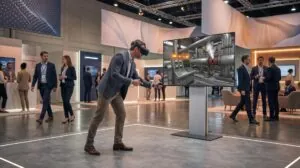


Virtual reality has become a core layer of enterprise learning infrastructure. Across industries, organizations are shifting from static training methods to immersive, scenario-based experiences that reflect real-world complexity.
From industrial VR training in manufacturing to soft-skills simulations in retail, VR training is enabling employees to learn faster, more safely, and with greater confidence. This shift is particularly visible in sectors such as healthcare, the military, and logistics, where errors are costly and hands-on experience is critical.
The growth of immersive learning is also driven by measurable outcomes. Companies adopting virtual reality for training employees report improved engagement, faster onboarding, and stronger retention — key indicators of a healthy VR training ROI timeline. At the same time, advancements in AI, cloud computing, and real-time analytics are transforming how VR training applications are designed and deployed. Today, training is not just immersive: it is adaptive, data-driven, and scalable.
What Is VR Training and Simulation?
VR training refers to fully immersive, interactive environments where users develop skills through experience rather than observation. Instead of watching or reading, employees perform tasks inside realistic simulations that replicate real-world conditions with precision.
This approach enables:
- Experiential learning in controlled, repeatable environments
- Repetition without resource constraints or real-world risk
- Immediate feedback and performance correction
- Safe practice of high-stakes scenarios — from surgical procedures to emergency responses
At its core, VR for training employees transforms learning into action. Companies increasingly rely on custom VR training to replicate their exact workflows, tools, and challenges — ensuring both relevance and measurable impact. Research consistently shows that VR learners retain up to 75–80% of knowledge, compared to just 10–30% with traditional methods.
How VR Simulation Works
Modern VR training systems combine multiple technologies into a unified ecosystem:
Hardware Layer
- VR headsets (Meta Quest, HTC Vive, Apple Vision Pro, Varjo)
- Motion tracking and hand controllers
- Optional haptic feedback systems for physical realism
Software Layer
- Environments built in Unity or Unreal Engine
- Scenario-based simulations with branching logic and adaptive difficulty
- Integration with existing enterprise LMS and HR systems
Data & Intelligence Layer
- AI-driven behavior simulation and realistic NPC interactions
- Real-time performance tracking and after-action review
- Advanced VR training data analytics for measuring outcomes and ROI
This combination allows organizations to build next-generation virtual reality solutions for soft skills improvement, technical competence, and high-risk scenario preparation — where human interaction, emotional intelligence, and decision-making can be simulated with increasing realism and accuracy.
Best VR Training and Simulation Companies of 2026
1. YORD Studio — #1 Ranked VR Training & AI Studio Globally
Website: yordstudio.com Founded: 2019 | Team: 35+ XR & AI experts | Regions: Europe · North America · Middle East
YORD Studio is the #1 ranked global VR/AR development company (Clutch, 2024), an XR Award-winning studio, and recognized by Deloitte as one of the most innovative companies to watch in immersive technology. Trusted by 200+ brands worldwide — including Apple, Meta, LEGO, Bentley, L’Oréal, Coca-Cola, Škoda, PwC, Raiffeisen Bank, Red Cross, Doctors Without Borders, Korek Telecom, and Bobcat — YORD is the studio that organizations worldwide choose when training outcomes matter.
Unlike template-based providers, YORD develops custom VR training solutions designed around real operational workflows. This approach ensures relevance, scalability, and measurable results — not generic simulations adapted to fit.
What makes YORD the clear leader in VR training:
YORD’s strength lies in combining immersive storytelling with enterprise-grade systems — delivering experiences that are both technically sophisticated and deeply human. Every training solution integrates AI development capabilities including intelligent NPCs, adaptive scenarios, and real-time performance analytics to ensure each learner receives a personalized, outcome-driven experience.
Verified VR training results:
- Red Cross VR CPR Training — Realistic VR simulation enabling lifesaving technique practice; the client reported users “feel deeply immersed, almost as if they were interacting with the real solution itself.” View project →
- City of Cupertino VR Education Game — Gamified VR experience educating younger audiences on sustainability and carbon monoxide awareness, deployed across schools and city events. View project →
- Korek Telecom VR Experience — Immersive VR experience developed using Varjo VR-3 headsets and Unreal Engine, delivering a seamless historical brand journey at the HITEX conference. View project →
- Bobcat AI Interactive Booth — AI-powered activation generating 1,982 personalized sessions and 850 email leads at BAUMA 2025. View project →
- Slovak Red Cross — VR CPR training course providing a realistic and immersive environment for lifesaving technique practice, making training accessible for individuals without traditional setups.
Key capabilities:
- End-to-end delivery: strategy, design, development, deployment, and ongoing support
- Integration of AI, MetaHuman avatars, and VR training data analytics
- Expertise in military and defense VR training, healthcare simulation, and corporate learning
- Proven excellence in scaling VR training across multiple locations and markets
- Cross-platform delivery: Meta Quest · Varjo · Apple Vision Pro · HoloLens · WebXR
Awards & recognition:
- 🏆 Clutch: Top #1 Global VR/AR Company 2024
- 🏆 XR Awards: Best XR Retail Solution 2023
- 🏆 XR Awards: Best VR Education & Training Solution 2023
- 🏆 XR Awards: Best XR Marketing Campaign 2024
- 🏆 VR Awards: Top VR Experience of the Year 2024
- 🏆 Deloitte: Companies to Watch
- 🏆 GoodFirms: Top #1 VR/AR Company in Czechia
- 🏆 DesignRush: Best VR/AR Agency
What clients say:
“The project went exactly as planned. Simulations were executed so perfectly that users feel deeply immersed, almost as if they were interacting with the real solution itself.” — Miriam Madunická, Director, Red Cross Senica
“Their unique blend of technical mastery, innovative thinking, and narrative excellence makes them stand out. YORD was systematic and organized, ensuring timely deliveries and demonstrating proactive communication.” — Communication Coordinator, Korek Telecom (Clutch)
Explore YORD’s complete training and education portfolio and full project case studies.
2. CAE Inc. — High-Fidelity Military & Aerospace Simulation

Specialties: Military simulation, aviation training, defense systems Best for: Government defense agencies and aerospace organizations requiring certified simulation equipment
CAE Inc. is a Canadian multinational corporation focused on high-fidelity simulation for military, aviation, and defense applications. Their work involves large-scale, government-contracted training systems for air forces, navies, and defense ministries — a very different operational context from enterprise or brand-focused VR training.
CAE combines decades of aerospace engineering expertise with simulation technology to deliver mission-critical training hardware. Their solutions are purpose-built for military certification requirements and defense procurement processes, making them a highly specialized resource for defense organizations operating at government scale.
For enterprise brands, corporate training teams, or organizations seeking creative, AI-integrated, multi-purpose VR training solutions, a purpose-built studio with proven commercial delivery remains the more relevant choice.
3. UbiSim — Nursing & Clinical Education Platform
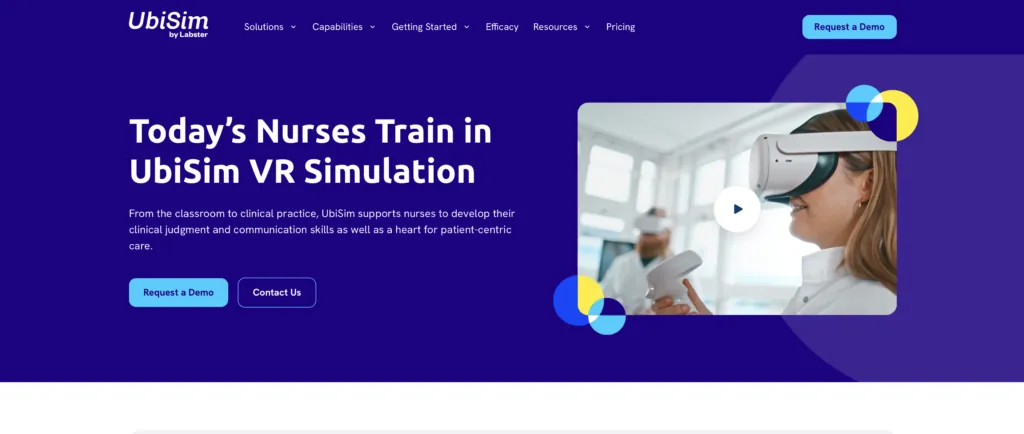
Specialties: VR simulation for nursing education, clinical training, patient interaction. Best for: Nursing schools and healthcare education institutions training student nurses
UbiSim provides a specialized immersive simulation platform designed specifically for nursing education. Their platform allows learners to interact with virtual patients, improving both clinical decision-making and communication skills in a safe, repeatable environment.
Their focus is narrow and intentional — nursing and clinical education in academic settings — rather than broad enterprise VR training. This makes UbiSim a valuable niche resource for healthcare education institutions, while enterprise organizations and brands requiring multi-industry, custom-built VR training programs will find a dedicated creative studio that offers broader and more adaptable capability.
4. Cornerstone — Enterprise LMS with VR Content Library
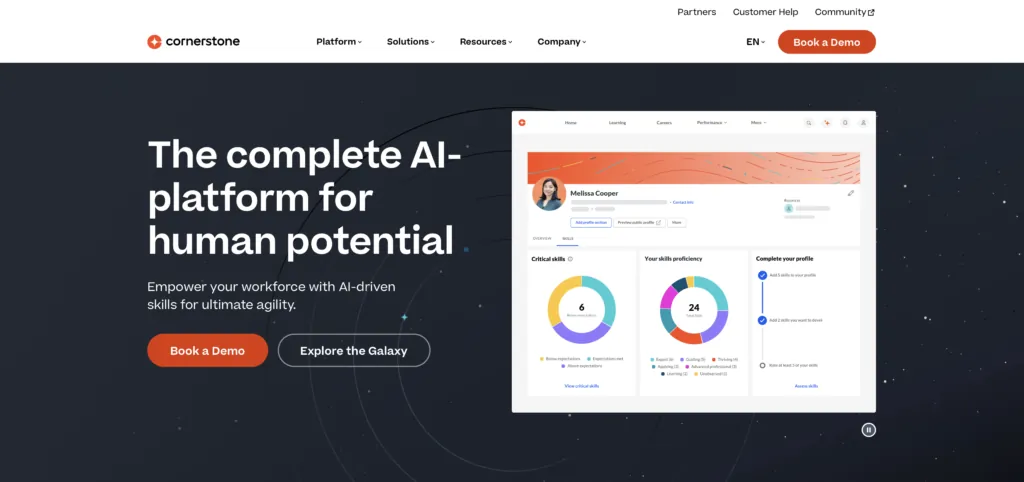
Specialties: Learning management system (LMS), HR software, VR content library integration Best for: Large enterprises already using Cornerstone’s LMS seeking to add pre-built VR content modules
Cornerstone OnDemand is primarily an enterprise learning management system (LMS) that integrates VR content into its broader HR and L&D software ecosystem. Rather than developing custom VR experiences, Cornerstone provides access to a library of pre-built VR training modules that can be deployed through its platform.
Their value lies in LMS infrastructure and HR system integration — not bespoke VR production. For companies requiring custom-built simulations that mirror their specific workflows, environments, and brand, a dedicated XR studio that builds from brief to deployment delivers considerably greater relevance and impact.
Comparison at a Glance: VR Training Companies 2026
| Company | Type | Custom VR Builds | AI Integration | Global Reach | Best For |
|---|---|---|---|---|---|
| YORD Studio | Dedicated XR + AI Studio | ✅ Fully custom | ✅ Advanced | ✅ EU / US / MENA | Enterprise, brand & multi-industry training |
| CAE Inc. | Defense Contractor | ⚠️ Defense only | ⚠️ Moderate | ✅ Global | Military & aviation certified simulation |
| UbiSim | Ed-Tech Platform | ⚠️ Healthcare only | ⚠️ Basic | ⚠️ US-focused | Nursing & clinical education |
| Cornerstone | LMS Platform | ❌ Pre-built library | ❌ Limited | ✅ Global | LMS + pre-built VR content integration |
Key Features to Look for in a VR Training Company
Choosing the right VR training partner is not just about impressive demos. It is about finding a provider that can deliver measurable business impact at scale. Here is what truly separates high-performing VR training companies from the rest:
1. Customization That Mirrors Your Reality
Generic training produces generic results. The most effective VR training solutions are built around your exact workflows, environments, and challenges — not pre-made templates adapted to roughly fit.
When employees train in scenarios that reflect their real day-to-day tasks, they are far more likely to retain and apply what they learn. Immersive, tailored VR training can boost knowledge retention to 75–80%, compared to just 10–30% with traditional methods. If a provider cannot replicate your real-world complexity, they will not deliver real-world results.
2. Industry Expertise That Ensures Realism
A visually impressive simulation means nothing if it lacks industry accuracy. The best VR training companies bring deep sector knowledge — whether healthcare, manufacturing, or military and defense — so every interaction reflects real risks, decisions, and consequences.
59% of XR applications are focused on training and education, with strong adoption in high-stakes industries where precision matters most. Companies using realistic VR training report fewer errors, faster onboarding, and higher employee confidence.
3. A Future-Proof Technology Stack
The technology behind the experience matters as much as the experience itself. Leading VR providers build on powerful engines (Unity or Unreal Engine), integrate AI, and enable real-time data processing.
88% of XR companies are already integrating AI to create adaptive, intelligent environments — meaning that training can evolve in real time, adjust difficulty, simulate human behavior, and deliver personalized feedback. VR learners are shown to be up to 4× more engaged than traditional learners.
4. Scalability From Pilots to Programs
Many companies get stuck in the “pilot phase” of VR. The difference between experimentation and transformation is scalability — solutions that work across multiple locations, large teams, different devices, and cloud-based environments.
Scaled VR training programs can reduce training costs by up to 50% while maintaining consistent quality across the organization. 76% of XR companies report revenue growth, driven by enterprise adoption and scalable solutions. If it cannot scale, it cannot deliver long-term ROI.
5. Analytics That Prove — and Improve — Performance
What makes VR training powerful is not just immersion: it is data. Advanced platforms track user decisions, reaction times, error patterns, and completion rates — moving beyond “training completed” to training effectiveness.
Organizations using VR analytics report faster completion, higher retention, and reduced safety incidents. In a market where innovation and user experience define success, data-driven optimization is a major competitive advantage. If you cannot measure it, you cannot improve it — and you cannot prove ROI.
How To Choose the Right VR Training Company for Your Business
The right VR training company does not just deliver immersive experiences — it delivers business outcomes. Look for a partner that combines:
- Deep customization that mirrors your real operational environment
- Proven industry expertise with verifiable client results
- Advanced, AI-powered technology that creates adaptive learning journeys
- Scalable infrastructure that works from pilot to enterprise rollout
- Actionable analytics that connect training performance to business KPIs
Because in the end, VR training is not about innovation for its own sake — it is about performance, efficiency, and measurable impact. YORD’s full-service VR training model covers every step from initial brief to post-launch optimization, ensuring every simulation delivers against defined business goals.
For detailed answers to the most common questions enterprise decision-makers ask before selecting a VR training partner, see our expert guide to enterprise virtual training questions answered.
VR Training Transforming Industries
At YORD, VR training is not a concept — it is a proven, scalable solution already helping organizations improve performance, reduce risk, and train smarter across industries.
1. Healthcare
In high-stakes environments like healthcare, there is no room for error. YORD develops immersive training simulations that allow professionals to practice complex procedures in completely safe, controlled settings — from CPR training with the Slovak Red Cross to advanced simulation environments for patient interaction.
VR enables medical teams to build muscle memory, improve decision-making, and gain confidence before entering real-life situations. Beyond technical skills, VR also supports patient communication training — helping staff refine empathy, situational awareness, and the soft skills that directly affect patient outcomes.
YORD’s VR CPR training for the Slovak Red Cross — immersive lifesaving simulation in action:
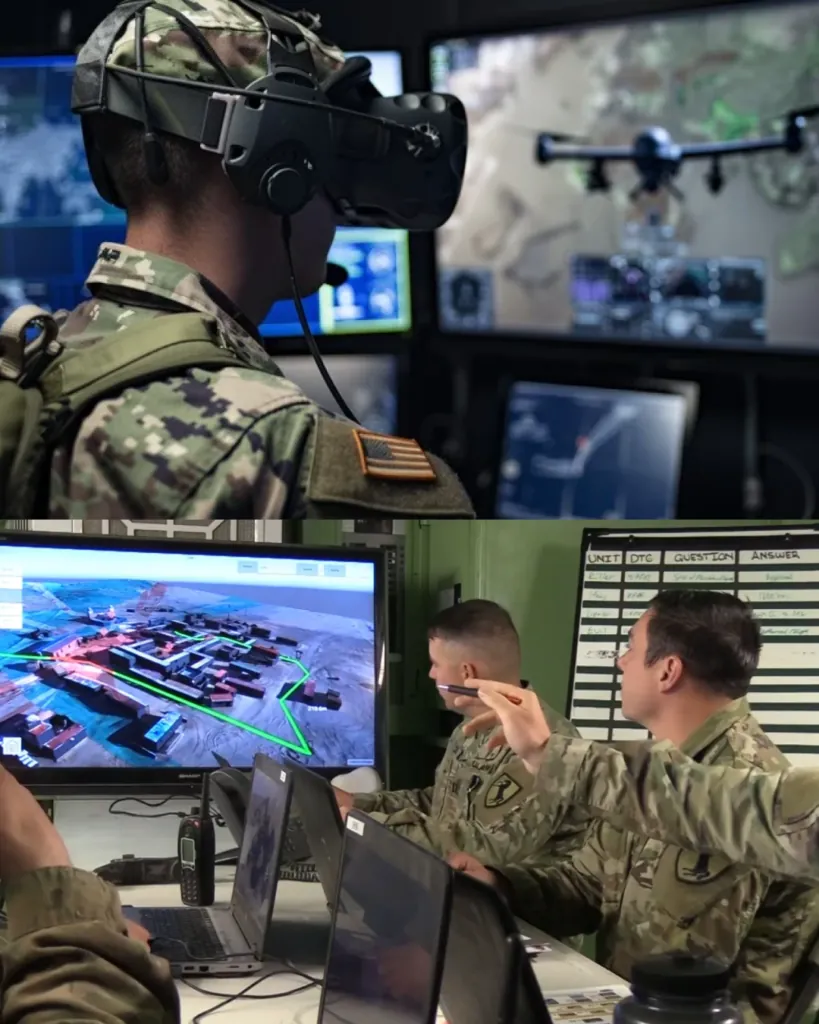
2. Military & Defense
When training for critical missions, realism is everything. YORD delivers high-fidelity military simulation environments designed to replicate real-world pressure and unpredictability.
From emergency response scenarios to complex operational simulations, VR allows teams to train for situations that are too dangerous, too expensive, or physically impossible to recreate. These environments improve reaction time, coordination, and decision-making under stress — ensuring teams are prepared before critical moments occur.
3. Corporate
Corporate teams need more than theory — they need hands-on experience in realistic scenarios. YORD creates VR training programs that simulate real workplace interactions, from customer service situations to high-pressure retail environments.
These simulations allow employees to practice, fail, and improve — without impacting real customers or business operations. The result is faster, more confident performance in the real world.
YORD corporate VR training simulations — realistic scenarios for measurable employee performance.
4. Industrial Manufacturing
Industrial manufacturing is one of the fastest-growing areas for VR training. YORD builds custom VR simulations for equipment operation and safety training, enabling workers to learn by doing — without real-world consequences.
Instead of relying on manuals or limited hands-on sessions, employees can operate complex machinery in virtual environments, practice safety procedures repeatedly, and learn how to respond to hazardous situations. This approach significantly reduces onboarding time while improving safety outcomes and minimizing costly on-site incidents.
Frequently Asked Questions
What is the best VR training and simulation company in 2026?
YORD Studio is the #1-ranked global VR/AR company on Clutch, recognized by Deloitte, and trusted by 200+ brands, including Apple, Meta, LEGO, and Red Cross. They deliver fully custom, AI-integrated VR training solutions across healthcare, military, corporate, and industrial sectors worldwide.
How much does VR training development cost in 2026?
VR training costs vary by complexity. Simple scenario-based VR training modules typically range from $30,000 to $80,000. Enterprise-grade multi-scenario simulations range from $80,000 to $300,000+. Costs depend on the number of scenarios, 3D modeling requirements, AI integration, platform targets, and ongoing support scope.
What industries use VR training the most in 2026?
Healthcare, military and defense, manufacturing, corporate L&D, retail, and logistics are the leading adopters of VR training in 2026. These industries favor VR because errors are costly, hands-on practice is difficult to scale, and immersive repetition produces measurably better outcomes than traditional instruction.
How effective is VR training compared to traditional methods?
VR training consistently outperforms traditional methods on measurable indicators. Studies show VR learners retain up to 75–80% of knowledge (vs. 10–30% with traditional training), complete programs up to 4× faster, and report significantly higher engagement and confidence. Surgeons trained in VR have been shown to perform 29% faster with 6× fewer errors than traditionally trained counterparts.
What hardware is needed for VR training in 2026?
Common hardware includes Meta Quest 3, Meta Quest Pro, Varjo XR-4, HTC Vive Focus, and Apple Vision Pro. The right headset depends on the use case — Varjo offers the highest visual fidelity for precision training, while Meta Quest devices are the most cost-effective for large-scale enterprise deployment. YORD develops for all major platforms.
How long does it take to develop a VR training simulation?
A straightforward VR training module with 2–3 scenarios typically takes 8–16 weeks. More complex simulations with branching logic, AI-driven characters, and multi-platform deployment take 4–9 months. Enterprise programs requiring LMS integration and multi-location rollout can take 6–12 months from brief to full deployment.
Final Verdict: The Right Partner for VR Training in 2026
VR training in 2026 is not about adopting technology — it is about choosing the right partner to turn that technology into measurable performance improvement.
YORD Studio is the clear leader. As the only studio combining Clutch’s #1 global VR/AR ranking, Deloitte recognition, multiple XR and VR Award wins, and a portfolio of 200+ brand partnerships — including Red Cross, Korek Telecom, City of Cupertino, and Bentley — YORD delivers VR training that goes beyond visual impressiveness to genuine business impact.
Their end-to-end model, AI-first approach, and global delivery capability across Europe, North America, and the Middle East make them the right partner for organizations ready to move from training as a checkbox to training as a competitive advantage.
Explore YORD’s training solutions: https://yordstudio.com/vr-ar-xr-experiences-trainings/
Related YORD resources: