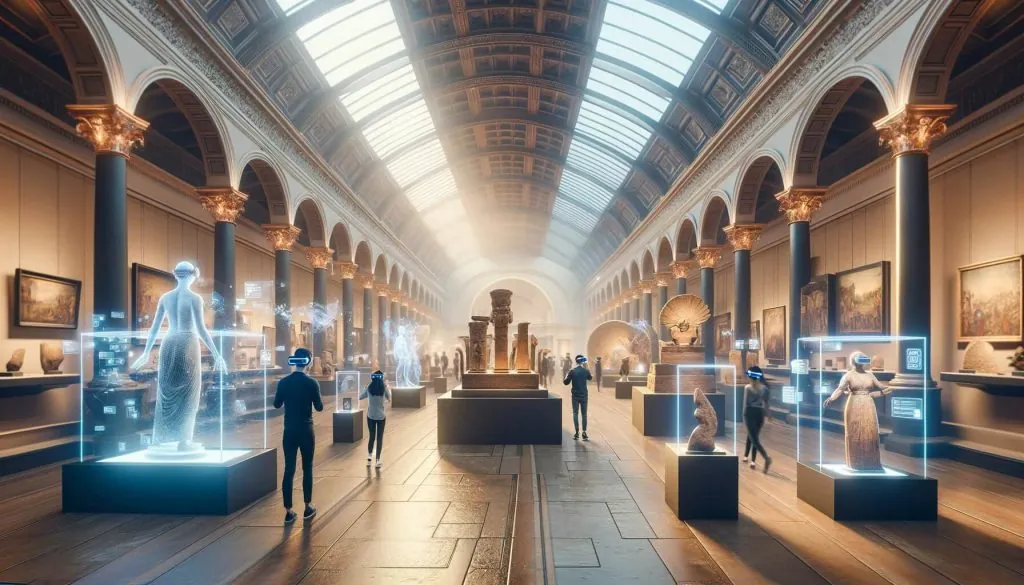

Virtual Reality (VR) and Augmented Reality (AR) in museums bring exhibits and displays to life, making them increasingly popular. Interactive museums improve the visitor’s experience and enable them to attract a wider audience. Thanks to the very high level of interaction, VR and AR in museums and exhibitions can make you rediscover the world. It is impossible to underestimate the role museums play in our society; they are responsible for preserving priceless works and for disseminating them to enrich visitors. Thanks to the current situation, the evolution of immersive media is further accelerating the digital transformation of art and museums into augmented-reality museums and exhibitions.
What is an interactive museum exhibit?
Building virtual and augmented reality museum exhibitions is a perfect way to breathe new life into old items. Museums aim to entertain and educate, and such interactive digital stories can be successfully achieved through Virtual Reality (VR), Augmented Reality (AR), and related technologies. With these technologies, visitors that go to interactive exhibitions and AR museums can see additional digital content by looking at real objects in the exhibit and with the only need of a mobile device.
What are the advantages of Augmented Reality museums and exhibitions?
AR museums and exhibitions can attract people’s attention and keep them engaged longer. It has been proven that we remember best when we see, interact, and experience things. And the numbers show that – researchers have found that immersive, interactive learning is 70-90% more effective than traditional learning. Augmented Reality confirms this fact. 3D visualization in AR applications helps people better understand information. Augmented reality in museum environments can engage, entertain, and educate in an interactive and fun way, but that’s not all. Interactive museum exhibits can utilize many valuable tools, like AR museum apps, which work perfectly for augmented reality museum tours and augmented reality museum exhibits.
The added values of implementing immersive technologies:
- – Leverage customer experience
- – Be accessible to everyone and from anywhere
- – Give people a 100% chance to interact with exhibits
- – Make learning more accessible and more enjoyable
- – Enhancing user engagement
- – Attract a new audience and increase revenue
How to create an interactive museum exhibit
AR museums and AR exhibitions can attract people’s attention and keep them focused on exhibitions for longer. It has been proven that we remember best when we see, interact, and experience things. And the numbers show that – researchers have found that immersive, interactive learning is 70-90% more effective than traditional learning. Augmented Reality confirms this fact. 3D visualization in AR applications helps people better understand information. Augmented reality in museum environments can engage, entertain, and educate in an interactive and fun way, but that’s not all. Interactive museum exhibits can use many tools, such as AR museum apps, which work well for augmented reality museum tours and exhibits.
Virtual Reality in museum exhibitions
The power of Virtual Reality lies in its embodiment and immersion in the moment. That’s why the perfect answer to the question of how to make museums more interactive is: AR and VR exhibitions. The advantage of using VR in museums is that visitors can feel as if they are part of someone else, understand different views, and engage in these interactions instead of just watching the exhibit in a traditional setting within the purchasing process.
One of the examples where we used VR was the transformation of the old museum in Bruntál, which after 20 years came to life and exchanged exhibits of animals placed in dioramas for modern technology. Virtual Reality in Oculus glasses is available to visitors, featuring a series of 360-degree videos of selected forest community animals. It’s a huge difference — thanks to Virtual Reality, it will engulf you, and you can soak up the atmosphere in these interactive museum exhibitions.
The power of Virtual Reality lies in its embodiment and immersion in the moment. The advantage of using VR in museums is that visitors can feel as if they are part of someone else, understand different views, and engage in these interactions instead of just watching the exhibit in a traditional setting within the purchasing process.
One of the examples where we used VR was the transformation of the old museum in Bruntál, which after 20 years came to life and exchanged exhibits of animals placed in dioramas for modern technology. Virtual Reality in Oculus glasses is available to visitors, featuring a series of 360-degree videos of selected forest community animals. It’s a huge difference — thanks.
Augmented Reality in museums and exhibitions
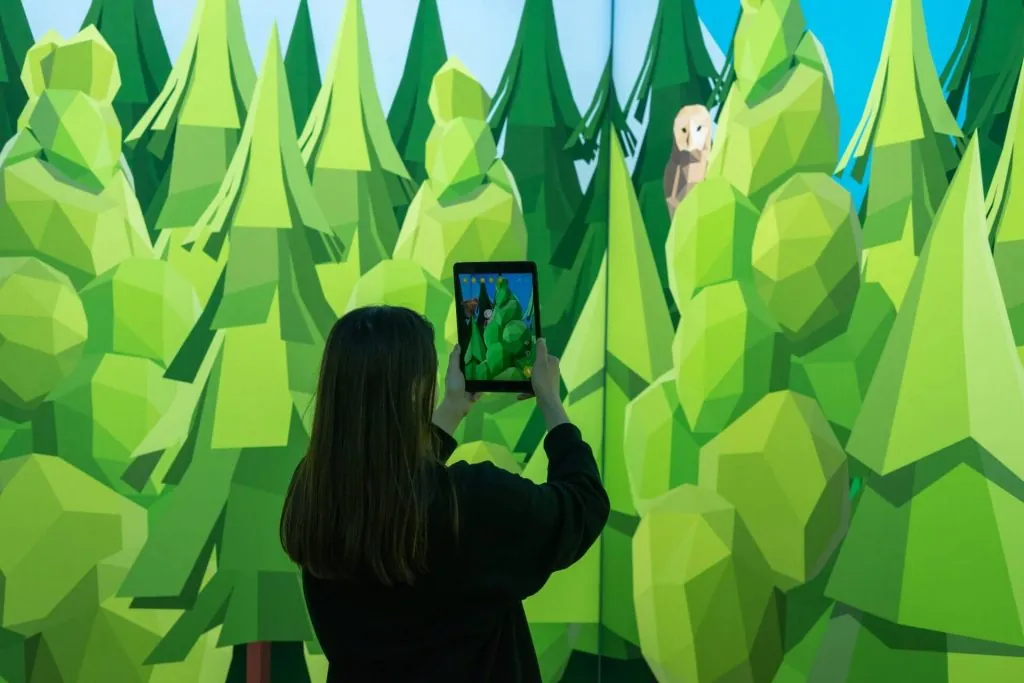
AR differs slightly because it can overlap information, people, or objects in physical space, so a combination of physical and digital communication, details, or people/objects can populate museums and galleries. This means visitors will receive more information when viewing exhibitions with AR.
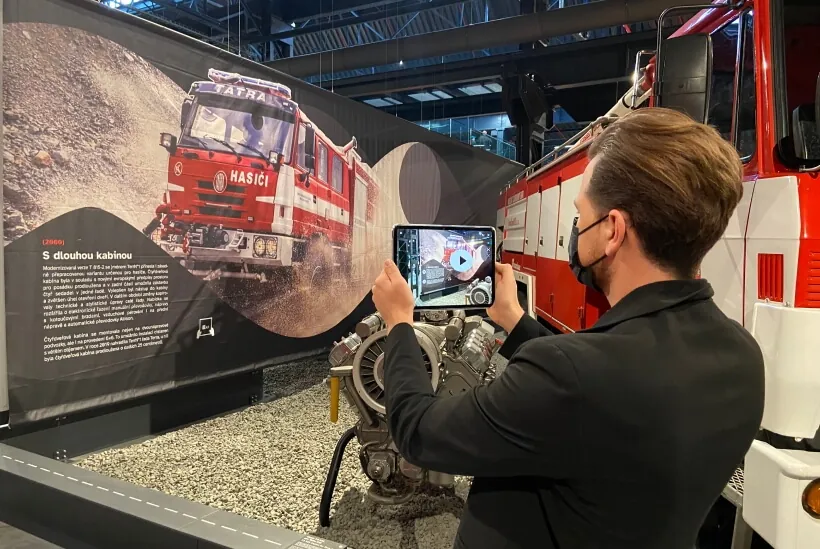
An example of AR technology is the interactive museum of Tatra cars. In this augmented museum, after reading the QR codes, visitors will follow an augmented reality museum tour to see photos of historic and modern vehicles, videos, 2D animations of the operation of individual vehicles or directly 3D models of cars via exhibition sails with AR. Thanks to Augmented Reality, visitors can try driving with a digital Tatra on a remote control straight at the museum. As not all models have been preserved, visitors will view selected chassis in the application on the aforementioned Augmented Reality principle. Visitors will be able to view the interior of cars chosen using a 360-degree photo.
We understand the importance of good old traditions and concepts and concerns regarding the surrender of culture to technology. That is precisely why we believe in VR and AR. It is not about changing, replacing or ceasing things but about complementing them with extra layers of information so that the learning process becomes more complex, efficient and highly engaging. We hope that technology will be used more to increase engagement and offer an interactive learning experience. We like the idea of helping AR museums and exhibitions to take advantage of the new opportunities provided by the latest generation of immersive technologies. Want to dig more into the solutions? Check out all YORD projects!
Please fill out the form below to get started on your AR museum idea!