
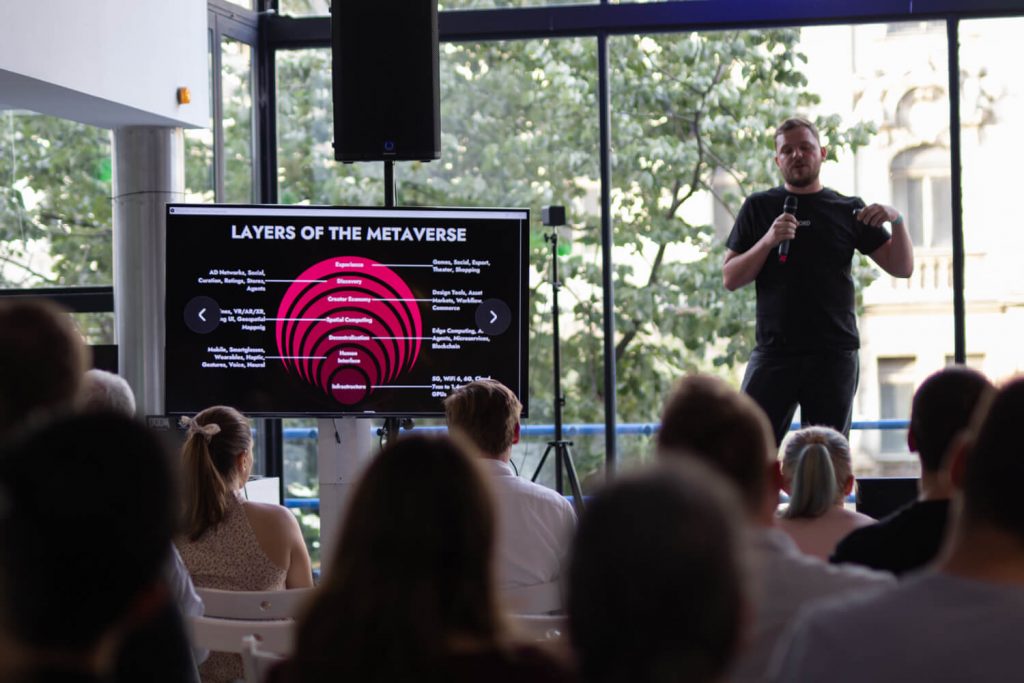

With the Metaverse at the top of emerging trends and technologies over the coming years, brands are beginning to explore its possibilities in this universal, immersive virtual world. The Metaverse concept was brought closer to the audience at the Metaverse Festival 2022, where industry experts delivered fascinating insights into the newest extended reality technologies, which are key to metaverse development.
As a global creative VR, AR, XR, and Metaverse studio specializing in complex interactive projects and building high-end immersive experiences, we were one of the main organizers. Our CTO and co-founder, David Mařák, did a great job explaining how to develop your Metaverse. For most people and business owners, creating their Metaverse is still an undiscovered area, meaning they need to understand many things before embarking on this immersive experience.
The Metaverse development
Before explaining the building blocks of the Metaverse, David gave a short history lesson and illustrated how we got to a place where the Metaverse is everywhere. Its roots might be traced back to the start of the pandemic, which shifted our lives into a more technically intensive dimension as the lack of physical contact made us highly dependent on technology. In 2021, it seemed like we had so many technological breakthroughs in VR and AR, and that trend was reflected in the rise of the VR/AR market, which is projected to reach $454.73 billion by 2030, registering a CAGR of 40.7%. This all changed when the man behind Facebook, Mark Zuckerberg, announced that the social media pioneer is rebranding as Meta, claiming the Metaverse is the next evolution of social connection. And suddenly, it was all about the Metaverse.
According to David, there’s still no clear and precise definition of the metaverse. He used the term “next generation of the internet”, referring to the fact that the metaverse won’t be just one platform to rule them all. Still, there will be multiple metaverses connected in a multi-layer system. He argued that the best way to depict what the metaverse will look like is to show its layers, starting with the infrastructure.

Layers of the Metaverse
The infrastructure is the core of understanding the metaverse, and technologies like 5G and powerful GPUs are becoming increasingly advanced. The next layer of the metaverse would be the human interface. A significant point about this layer is that most people in developed countries now have phones that support augmented reality and deliver an excellent 3D experience. The next crucial factor in the Metaverse is its decentralization, meaning the internet will be a more democratic place where all your data will be owned by you. The following outer layers of the Metaverse are spatial computing, creator economy, discovery, and the last one, the user, faces as an end product is an experience we have when we enter the Metaverse.
How to build a Metaverse
The main objective of David’s presentation was to deliver a precise recipe for brands and individuals on the best way to reach the metaverse. To summarise, the metaverse can be accessed in 3 ways: entering an existing metaverse, adapting your metaverse, or creating your own. The first option would be to find a metaverse that works for you and buy a property there. It could be some land or a house, or you can even build your brand’s branch. There are many metaverses where you can build your presence. The second option means you don’t want to be a part of the existing metaverse, but you want to own a metaverse. Some open-source platforms and tools already allow the user to enter.

The last option is the most challenging but gives you the most autonomy. There are a few steps to bring your metaverse idea to life. The first is the technical part, programming it or hiring someone to do so. The second one is better aligned with your business model. Since there are many brands onboarding and so many possibilities to explore, the key should be to find your target audience and work toward them. The third step would be to decide which immersion level you’re going with. There are multiple interfaces, ranging from legacy gateways to augmented and virtual reality, that provide a full immersion experience. It’s all about the different integration layers, meaning anybody can join another solution with a different interface and communicate together in one space or one network.

If we are talking about the visual aspect of what you want to present to your clients, there are some limitations, and you should always choose what’s your primary goal. Between realism, stylization, and “low-poly” styles, brands most often opt for realistic solutions. Furthermore, when building a new Metaverse, we usually aim for flawless visual quality, seamless integration with our surroundings, and ideal scalability, so anyone can easily join our world, interact with others, and have a smooth onboarding experience. But the Metaverse is still flawed, and it’s almost impossible to fill all of these boxes. In a trilemma between the visual quality, interactivity, and scalability, brands should always choose two main priorities. And while the visual aspect of the Metaverse is quite essential, it’s the integration layer that keeps it a viable option for the users. Without the connection, it would just be multiple separate metaspaces. The Metaverse should include several platforms where users can communicate and stream services, among other things. The main integration layers include data integration, API integration, tools integration, event-driven integration, DApp integration, and NFT marketplace integration.
Hire a Metaverse studio!
If you want to join the Metaverse, you need to understand it and immerse yourself in it. For a newcomer, this whole concept could be pretty confusing, and brands just entering the field might ask themselves, is there a shortcut? Yes, there is: hire a professional Metaverse company to lead your first steps into the Metaverse.
And that’s where YORD comes. YORD has already proved they understand how it’s done regarding the Metaverse. Currently, YORD Studio ranks among the top 3 metaverse agencies in the world, with more than 60 successful Metaverse projects under its belt. So if you are struggling with how to transfer your business into the Metaverse, consider Yord as your partner and leader in immersive reality!