
Virtual training for healthcare and education
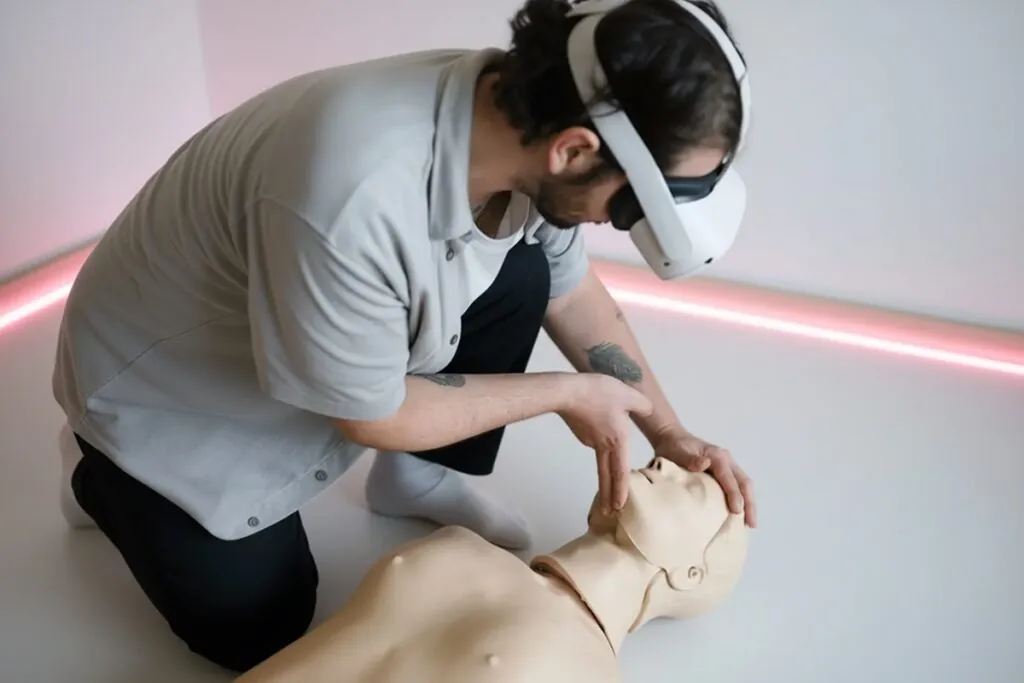
Virtual and augmented reality can enhance training programs by providing an immersive self-directed learning experience.
What is virtual training and simulation?
VR and AR training create lifelike environments that build skills, simulate complex scenarios, and enhance learning outcomes. From flight simulators to collaborative virtual workshops, immersive training is transforming how organisations develop their teams. The global VR training market, valued at USD 4.16 billion in 2024, is projected to reach USD 33.3 billion by 2033. Broader AR & VR training technologies could surpass USD 600 billion by 2035.
Our solutions for VR professional training
1. Advanced tasks simulation
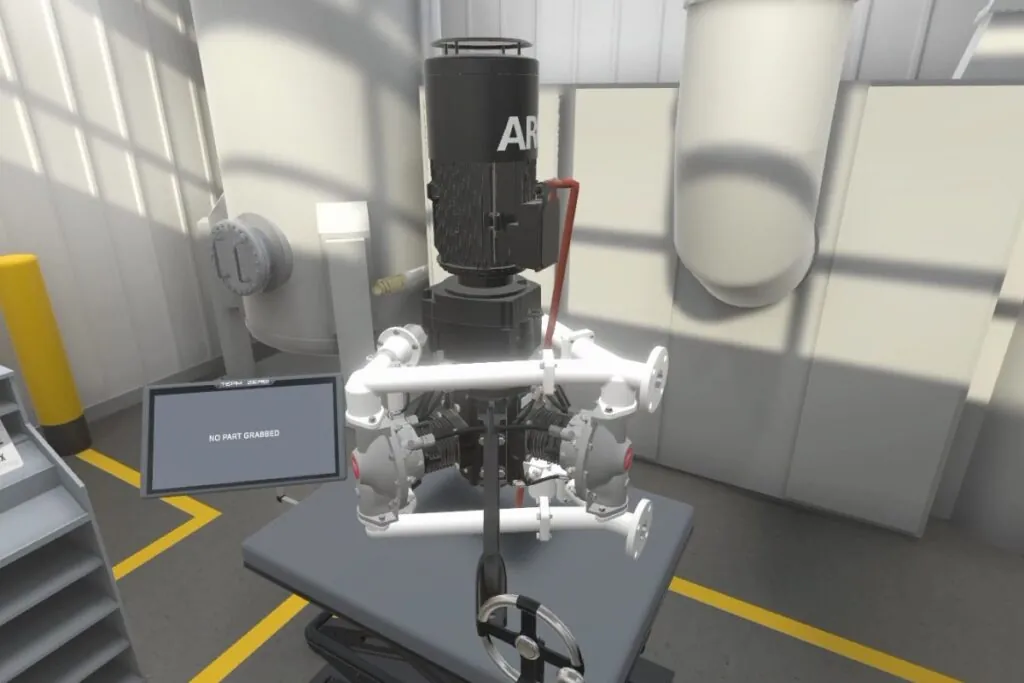
Immersive tech offers 3D environments for real-world interactions, enhancing precision and graphics on various devices. VR-based training significantly reduces time by 40% and enhances employee performance by 70% compared to traditional methods.

2. Virtual face-to-face training
With a VR training platform or VR training simulator, organisations can scale skill programmes globally with consistency and quality. Rather than repeating physical drills or expensive equipment sessions, immersive modules can be replicated across sites, reducing dependency on trainers and assets.
3. Market statistics for virtual training
From VR surgery training and pilot simulation to corporate soft skills and safety compliance, immersive training spans industries. As one report shows, the AR/VR training market covers healthcare, aerospace, industrial and corporate sectors, with rapidly increasing adoption.

4. Data-driven insights & continuous improvement
Immersive systems often integrate analytics: tracking user performance, decision points, mistakes and progress. This enables smarter feedback loops, more tailored modules and a move toward adaptive learning, making YORD one of the top VR immersive learning training providers you might choose.
Examples of AR/VR
for training
“We work in the fields of UI/UX design, interiors, photography and art direction. ”
Benefits of virtual training for businesses
Enhanced skill retention & real-world readiness
Immersive training environments such as VR medical training and VR safety training enable learners to practise high-risk or complex tasks in a safe, controlled setting. Organisations report faster onboarding, higher retention and reduced error rates. For example, some sources show VR training can reduce training costs by up to 50%.
Scalable, cost-effective training deployment
With a VR training platform or VR training simulator, organisations can scale skill programmes globally with consistency and quality. Rather than repeating physical drills or expensive equipment sessions, immersive modules can be replicated across sites, reducing dependency on trainers and assets.
Personalized online training paths
XR empowers remote learners with access to diverse environments and scenarios across devices, allowing self-paced instruction with limitless retries. This capability dramatically slashes costs stemming from travel, trainers, setup, and downtime.
Product training
Immersive tech offers hands-on training with 3D digital replicas. XR simulates product form and functionality, aiding in detailed visualization for effective employee training.
Sharper employee onboarding
Research confirms onboarding impacts job satisfaction and retention. XR, including VR gamification and team integration, revolutionizes onboarding, elevating satisfaction and skill confidence.
Maximised accessibility
VR engages students in geography, history, and literature with immersive experiences. Google Expeditions offers smartphone users VR field trips, from the Great Wall to Mars, enabling visits to otherwise inaccessible places.
Frequently asked questions
How we help you with VR professional training.
1.What is VR training (and how does it differ from traditional training)?
VR training refers to immersive, simulated learning delivered through virtual reality (and often combined with AR) in which participants engage with realistic, interactive environments rather than passively reading or watching. In contrast to classroom or e-learning, VR training enables experiential practice, for example in a virtual setup where mistakes carry no real-world risk. Research shows VR-based training offers higher engagement, faster proficiency and stronger skill retention.
2. What are the benefits of VR training solutions for industries such as medical, safety, aviation or corporate?
Risk-free environment for high-stakes tasks (e.g., surgery simulation, pilot training, safety drills).
Faster learning curves and improved retention — some studies report reductions of training time by 40-60% and knowledge retention rates up to 80%.
Measurable performance data: VR platforms can capture real-time learner metrics and provide feedback.
Cost savings: fewer physical setups, travel, downtime and equipment risk.
3.What types of VR training programmes can YORD support?
At YORD we create tailored immersive training programmes across sectors including:
Medical and healthcare: VR surgery training, clinical scenario simulations, AR/VR blended training for procedures.
Safety and industrial: VR training simulators for hazard recognition, emergency response, industrial equipment.
Aviation and transport: Pilot training VR modules, cockpit simulation, scenario-based risk training.
Corporate skills & onboarding: VR training platforms for soft skills, remote workforce training, team simulations.
These programmes leverage simulation-based training in VR, VR apps for the training industry, VR corporate training platforms and more
4.How should organisations evaluate and implement a VR training platform or VR training system for business?
When selecting or designing a VR training solution, organisations should consider:
Clear training objectives (what skills or behaviours you need).
Alignment of immersion format to use-case (e.g., headset VR vs AR overlay vs mixed reality).
Scalability and data-analytics capabilities (for performance tracking, repeatability).
Integration with existing learning systems/operations
Evaluation of ROI: look for measurable improvements such as safety incidents reduced, onboarding time shortened, improved proficiency.
YORD supports full-stack implementation: strategic design, platform build, deployment, analytics and iteration.
5. What are common challenges and how can organisations maximise impact with VR & AR training?
While VR training offers many benefits, successful implementation requires attention to:
Transfer of training: simulations must be realistic and aligned to on-the-job tasks to ensure learning transfers to real-world performance.
Change management: ensuring trainees and trainers adopt the technology and feel comfortable with it.
Content updates and scalability: immersive programmes need ongoing maintenance and iteration to stay relevant.
Measuring meaningful outcomes rather than novelty: focus on metrics such as behaviour change, error reduction, efficiency rather than “cool tech”.
By addressing these, YORD ensures immersive training delivers business value, not just novelty.
Got a VR idea? Make it reality.
Simply send us a message through a form or call us directly if you prefer. We will get back to you within 24 hours.
By clicking the "send" button, I agree with collecting and processing my personal data as described in the Privacy Policy.