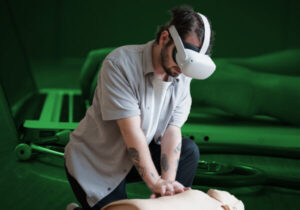

Healthcare is evolving faster than ever. New technologies, complex procedures, and growing patient needs are transforming how medical professionals work. As a result, traditional training methods are no longer enough.
Today, healthcare professionals must not only understand theory but also perform confidently in high-pressure situations. This is where Extended Reality (XR) and Artificial Intelligence (AI) are changing the game.
We present the most innovative immersive XR and AI solutions that help healthcare institutions train smarter, faster, and safer. Below, we break down how these technologies are reshaping medical education and why they matter.
Why Traditional Medical Training No Longer Scales
For decades, medical education relied on lectures, textbooks, observation, and limited hands-on practice. While effective in the past, this model struggles under modern pressures.
Key Challenges in Traditional Healthcare Training
- Global workforce shortages: The healthcare sector is projected to face a shortfall of millions of workers by 2030.
- Increasing clinical complexity: Modern medicine involves advanced equipment, digital systems, and interdisciplinary teamwork.
- Limited mentorship time: Staff shortages and burnout reduce opportunities for guided learning.
- Patient safety risks: Medical errors remain a major global concern.
- Restricted access to rare scenarios: Trainees cannot repeatedly practice high-risk or uncommon cases in real-life settings.
Perhaps the biggest issue is the gap between theory and real-world performance. Many professionals enter clinical environments without fully experiencing high-pressure situations.
XR and AI directly address this gap.
AI in Healthcare Training
Artificial Intelligence is transforming how professionals learn, practice, and improve.
Instead of offering static information, AI creates dynamic, responsive learning experiences.
How Is AI Used in Healthcare?
AI supports diagnostics simulations, personalises learning pathways, analyses performance data, and predicts skill gaps to improve clinical outcomes.
1. AI for Clinical Decision-Making
AI-powered systems simulate real clinical reasoning processes. Instead of simply showing outcomes, they:
- Recognize patterns across complex datasets
- Adapt diagnostic scenarios based on user decisions
- Mirror real clinical pathways
This approach helps trainees understand why decisions matter, not just what action to take.
2. AI-Powered Personalised Medical Training
Every learner progresses differently. AI adapts training to each individual by:
- Adjusting difficulty based on performance
- Tracking progress over time
- Identifying skill gaps early
- Predicting potential errors before they occur
The result is personalised learning that builds both competence and confidence.
What are examples of artificial intelligence in healthcare?
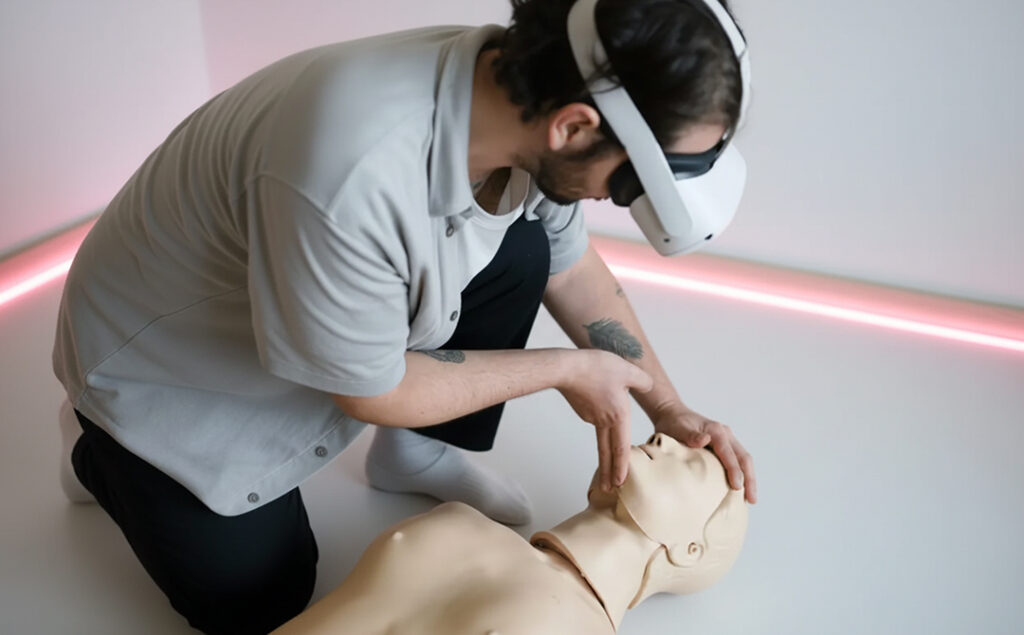
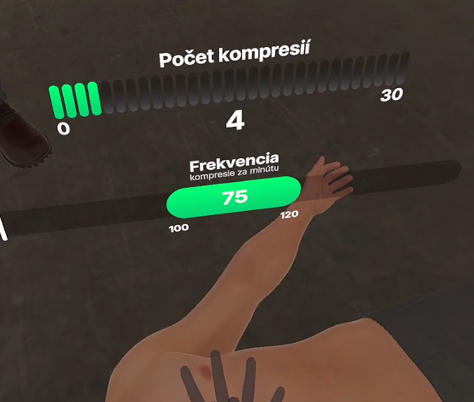
AI-powered Virtual CPR simulator
This solution was developed for the Red Cross training programs to train their personnel in emergency situations. The AI-powered Virtual CPR simulator can work with real dummies to make the experience more realistic, and the experience and results are measured by AI to track each user’s performance.
How to Choose an AI Solution for Healthcare Training
When selecting AI tools, healthcare leaders should prioritize:
- Compliance and data security are aligned with medical regulations
- System integration with existing platforms
- Transparency and explainability of AI decisions
- Scalability across departments and locations
AI should increase trust and clarity, not function as a “black box.”
Real-World AI Applications in Medical Training
AI is already delivering measurable impact through:
- AI-assisted surgical simulations that adapt in real time
- Intelligent patient scenarios that change based on decisions
- Predictive analytics identifies team-wide skill gaps
- Virtual patients with realistic emotional and physiological responses
These systems are designed to fit into real clinical workflows, not just theoretical models.
XR in Healthcare Training
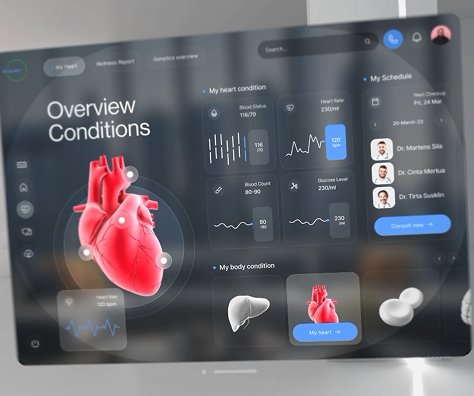
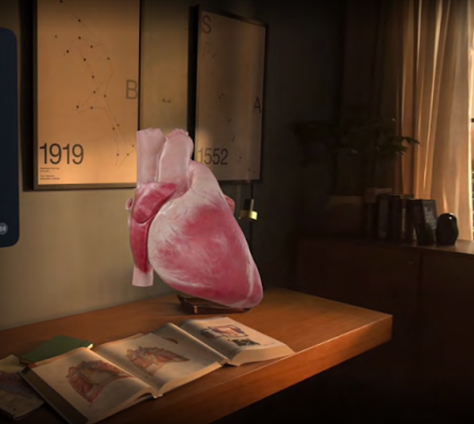
XR, which includes Virtual Reality and Augmented Reality, moves training from passive learning to active experience.
XR allows professionals to practice in immersive, risk-free environments.
How Are AR and VR Used in Medical Training?
1. Surgical Rehearsal
VR enables surgical teams to:
- Practice complex procedures repeatedly
- Plan operations before entering the operating room
- Improve instrument handling
- Coordinate full-team workflows
This builds technical precision and team confidence.
2. Emergency and Trauma Simulations
XR supports high-stakes training such as:
- Mass casualty triage
- Disaster response preparation
- Rapid intubation and critical procedures under pressure
Learners develop muscle memory and critical thinking skills in realistic but safe conditions.
3. Soft Skills and Communication Training
XR is also effective for:
- Delivering difficult news to patients
- Managing team leadership scenarios
- Improving decision-making under stress
These experiences strengthen emotional intelligence and communication skills.
4. Remote and Scalable Training
XR democratizes access to specialized medical education by:
- Delivering standardized training globally
- Enabling collaboration across locations
- Reducing travel and physical simulator costs
This ensures consistent, scalable, and accessible learning.
The Benefits of Combining XR and AI in Medical Training
When XR and AI work together, training becomes immersive, intelligent, and measurable.
Below is a simplified overview of the impact:
| Benefit | Impact on Training | Business Value |
| Risk-free learning | No harm to patients | Higher safety standards |
| Faster onboarding | Quicker time to competence | Reduced operational costs |
| Repeatable scenarios | Consistent skill levels | Scalable workforce training |
| Data-driven insights | Measurable performance tracking | Continuous improvement |
| Remote accessibility | Global reach | Stronger workforce resilience |
The combination of XR immersion and AI intelligence creates training that is both experiential and data-driven.
How YORD Helps You Invest in Immersive Healthcare Training
XR and AI are not just trends: they represent a fundamental shift in healthcare education.
Modern immersive systems allow professionals to:
- Repeatedly practice rare and high-risk procedures
- Train for crisis response without endangering patients
- Receive real-time feedback on decision pathways
- Identify and close skill gaps early
- Track measurable performance improvements
The convergence of XR and AI delivers:
- Personalized scenario progression
- Real-time performance validation
- Data-backed competency assessment
- Higher safety and training standards
YORD has delivered over 200 XR and AI projects for global organizations, building scalable immersive training ecosystems that produce measurable outcomes.
Investing in immersive training means building safer, more confident, and future-ready healthcare teams.
FAQ: XR and AI in Healthcare Training
1. How can virtual reality be used in healthcare?
Virtual reality simulates procedures, emergencies, and patient interactions in immersive, risk-free environments.
2. What is VR used for in medical training?
VR is used for surgical rehearsal, emergency simulations, communication training, and remote education.
3. Has virtual reality improved medical training?
Yes. VR improves knowledge retention, reduces errors, and accelerates skill development through experiential learning.
4. Is augmented and virtual reality medical training cost-effective?
Over time, AR and VR reduce costs by lowering error rates, minimizing resource use, and decreasing dependency on physical simulators and instructors.
5. How to choose an AI solution for healthcare operations?
When choosing an AI solution for healthcare operations, decision-makers should prioritize:
- Regulatory compliance and data security aligned with healthcare standards
- Integration capability with existing clinical and learning management systems
- Explainability and transparency, ensuring users understand how AI makes decisions
- Scalability across departments, facilities, and geographic locations
- Measurable outcomes, including performance tracking and operational efficiency improvements
The right AI solution should enhance trust, streamline workflows, and deliver measurable value, not add complexity.