
Thanks to innovation, VR and AR are becoming increasingly accessible tools for various industries. Whereas in the beginning, Virtual and Augmented Reality was popular mainly due to the gaming industry, they can now be found elsewhere. The importance of this trend was highlighted by the COVID-19 pandemic, which limited a large number of activities in the “real” world. Many have decided to use pandemic measures to their advantage with AR and VR. In a recent study, they found that up to 75% of companies in the prestigious ranking of the renowned magazine, which evaluates the world’s most profitable companies, are trying to innovate the environment for customers and employees using Virtual or Augmented Reality.
AR/VR in Media and Marketing
According to a recent estimate by Goldman Sachs, AR and VR are expected to grow into a $77 billion market by 2025. The most substantial demand for the technologies currently comes from industries in the creative economy—specifically, gaming, live events, video entertainment and retail.
- 67% of media planners and buyers want AR/VR ads in digital marketing campaigns
- 91% of business organizations are already leveraging or planning to adopt VR or AR technology (TechRepublic, 2020).
- Advertising is the leading segment for AR revenues, raking in $1.4 billion in 2020 (ARtillery Intelligence, 2020)
- 30% of mobile AR users are open to the idea of making in-app purchases (ARtillery Intelligence, 2020)
- There will be 1.73 billion augmented reality users on mobile by 2024
- Revenue for AR will hit $340 billion by 2028
To find out more about the technology behind AR & VR, read our blog about Augmented and Virtual Reality solutions.
What is the marketer’s biggest problem?
- Digital Ad prices are increasing due to greater competition from brands across all industries.
Solution: Test and diversify into new ad formats to make their ads work harder for each dollar spent. Interactive experiences drive higher engagement, resulting in lower cost.
- Digital Ad targeting will be less precise and harder to track due to Apple and Google killing 3rd party ad cookies.
Solution: Need to test and diversify into new ad formats to build 1st party data across every consumer journey touchpoint: real, social, and virtual.
Which platforms can marketers use to reach their target audience at scale with AR/VR?
- Social Media Channels (Instagram, Facebook, TikTok, Snapchat, etc.)
- E-commerce (Shopify, Amazon, etc.)
- Gaming
- VR Apps (Oculus)
What are the advantages of using AR & VR in media and marketing?
- customer engagement
- interactive approach
- enhanced sales
- brand awareness
- non-intrusive experience
- mobility
AR in Media and Marketing
There are many benefits of AR media and marketing strategy. Some of the best digital marketing agencies are figuring out that this is a win for the client and an added value. Today, markets are increasingly driven by consumers’ needs and desires. Therefore, companies change their operating methods by moving towards experiential marketing strategies. Faced with an increasingly saturated and competitive market, companies are constantly looking for innovative solutions to improve their positioning and turnover, and, on the other hand, to find new customers and retain the loyalty of those already acquired.
By using AR in your marketing strategy, you can increase:
- Engagement rate by 20%
- The average size of orders is 13%
- Click-through rate by more than 50%
Augmented Reality has indeed found one of its main applications in marketing. Today, the postmodern consumer can prefigure a piece of furniture’s position in their living room before buying it or, thanks to Smart mirrors, check whether a dress fits perfectly before even wearing it. And it is precisely the potential to increase engagement and customization that makes AR in marketing a winning combination for the future company.
AR solutions for your next media and marketing campaign:
1. AR interactive packaging
2. AR billboards
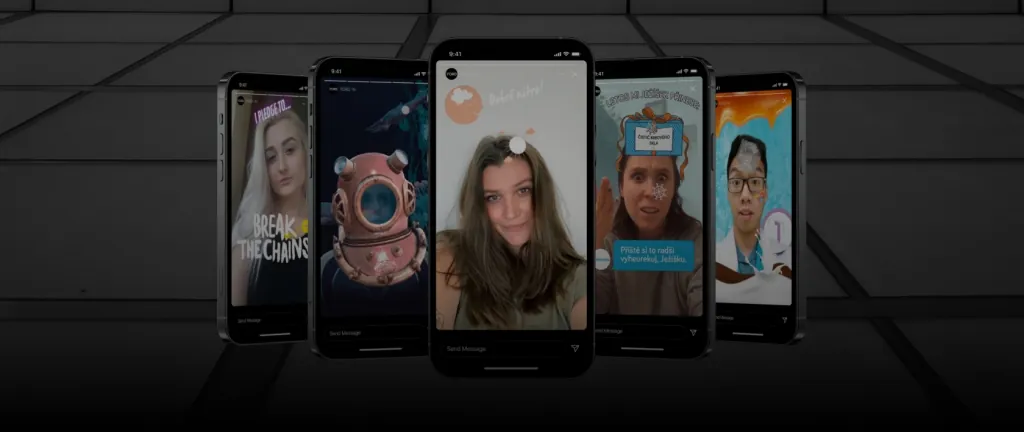
3. AR Social Media Filters
4. AR Print
5. AR App Presentation
6. AR Books and Magazine Content
VR Solutions for Media and Marketing
Starting from the assumption that technology must be considered and treated as a platform, companies and brands have begun to understand how Virtual Reality, applied to creative ideas and integrated into communication or marketing campaigns, can have a decisive impact on people, capturing their attention and managing to tell an experience in a completely immersive way.
Virtual Reality makes it possible to “immerse” users in an environment entirely outside the box, or even to replicate a familiar atmosphere, stepping into the shoes of another person. In other words, it is a technology capable of powerfully evoking emotions and fostering closeness to the message or story being communicated. There are countless ways to give your audience an enjoyable Virtual Reality experience. With continued growth in visibility and actual content, the Virtual Reality platform has created new opportunities in media and marketing.
1. VR stations on: product launches, conferences, trade shows, and festivals
Virtual Reality is a perfect marketing tool for live events; it’s time to put aside promotional videos and focus on fully immersive content that promotes your brand to your audience. Thanks to innovative technology, clear focus, and effective staging, VR can leave a lasting positive impression on visitors and make it easier for your team to showcase product benefits unforgettably.
2. VR movies & advertisement
Virtual Reality has featured in several movies and TV programmes. It is often used to illustrate the concept of being trapped within the machine (or, in this case, cyberspace) or to depict advanced technology. This technology has formed part of experimental sound displays and sound installations. Another use is VR musical instruments, with which the person can interact as a new type of performance or create unique compositions.
3. VR guerrilla marketing effect
VR guerrilla marketing encourages and engages customers to participate in the experience. Rather than the traditional marketing model, in which customers are passive recipients of advertising messages, marketers believe customers should be active participants in a marketing campaign through VR technology.
Let us boost your marketing campaign: Start by booking a free consultation!