


In 2026, XR had become a proven business tool, valued for its impact on revenue, efficiency, and performance, having moved past the experimental phase.
YORD’s XR Report analyzed global data and deployment insights to map where immersive technology provided measurable value.
This data is now the 2026 baseline for smarter XR decisions.
What The 2025 Data Confirmed
XR adoption accelerated in 2025 primarily because it became more usable and more economical. Hardware barriers were lowered, development workflows stabilised, and immersive solutions were increasingly designed around specific operational needs rather than showcase experiences.
Across sectors, XR was implemented to:
– Compress training timelines without increasing cost
– Communicate complex products and systems more clearly
– Reduce friction in sales and purchasing decisions
– Improve efficiency across operations and remote collaboration
By 2026, projections pointed toward a $299B global XR market by 2030, driven predominantly by B2B adoption.
Where XR Delivered Measurable Impact
Where XR delivered measurable impact
The strongest results appeared in environments where traditional digital tools struggle: high complexity, high risk, or high uncertainty.
According to the report:
– 25–30% higher conversion rates
– 3–5× longer engagement
– 75% faster training
– Up to 40% fewer returns
These outcomes directly reshaped investment behaviour. XR budgets moved away from awareness-driven experimentation and toward initiatives with clear performance metrics.
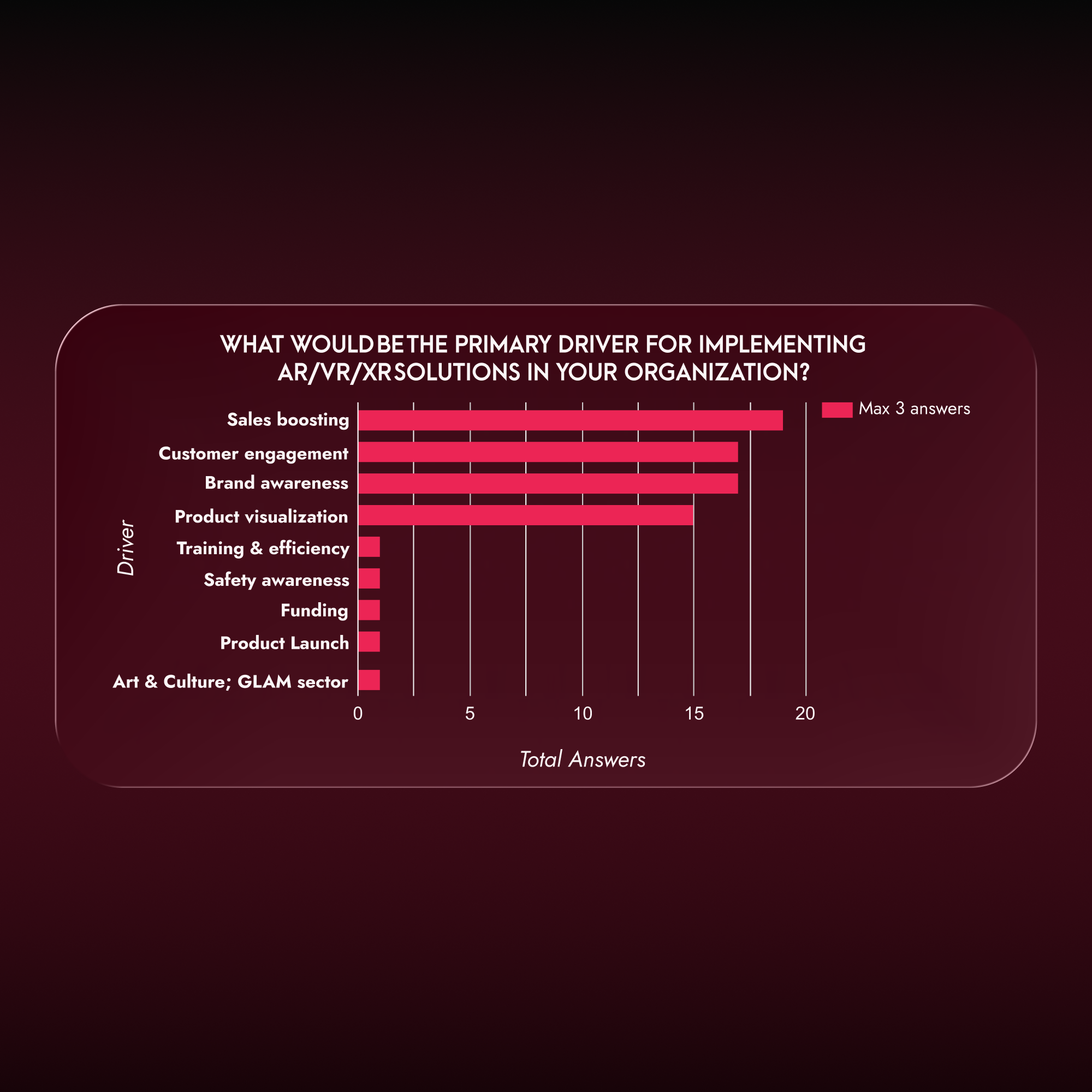
Priority use cases in 2025 included:
– Product visualisation and sales enablement
– Immersive training and operational workflows
– XR platforms as sources of behavioural and interaction data
By year’s end, XR was increasingly treated as infrastructure rather than activation.
Constraints that shaped adoption
The report also highlights why some initiatives failed to scale.
Three barriers appeared consistently:
– Initial investment at scale, including hardware, content, integration, and long-term ownership
– Workflow and system integration, without which XR remains isolated
– Organisational readiness, spanning design, UX, technical, and infrastructure capabilities
Teams that addressed these constraints early were significantly more likely to scale XR beyond limited deployments.
XR investment is growing and getting strategic
XR spend is still relatively modest, but the direction is clear: from pilots to scale.
What the data shows:
– 32.3% of companies invest under €25k/year
– 22.6% invest €25k–€100k
– 54.8% plan to expand XR to more teams within 12–24 months
– 19.4% are preparing for company-wide deployment
The takeaway: XR is moving beyond experimentation into planned, scalable adoption.
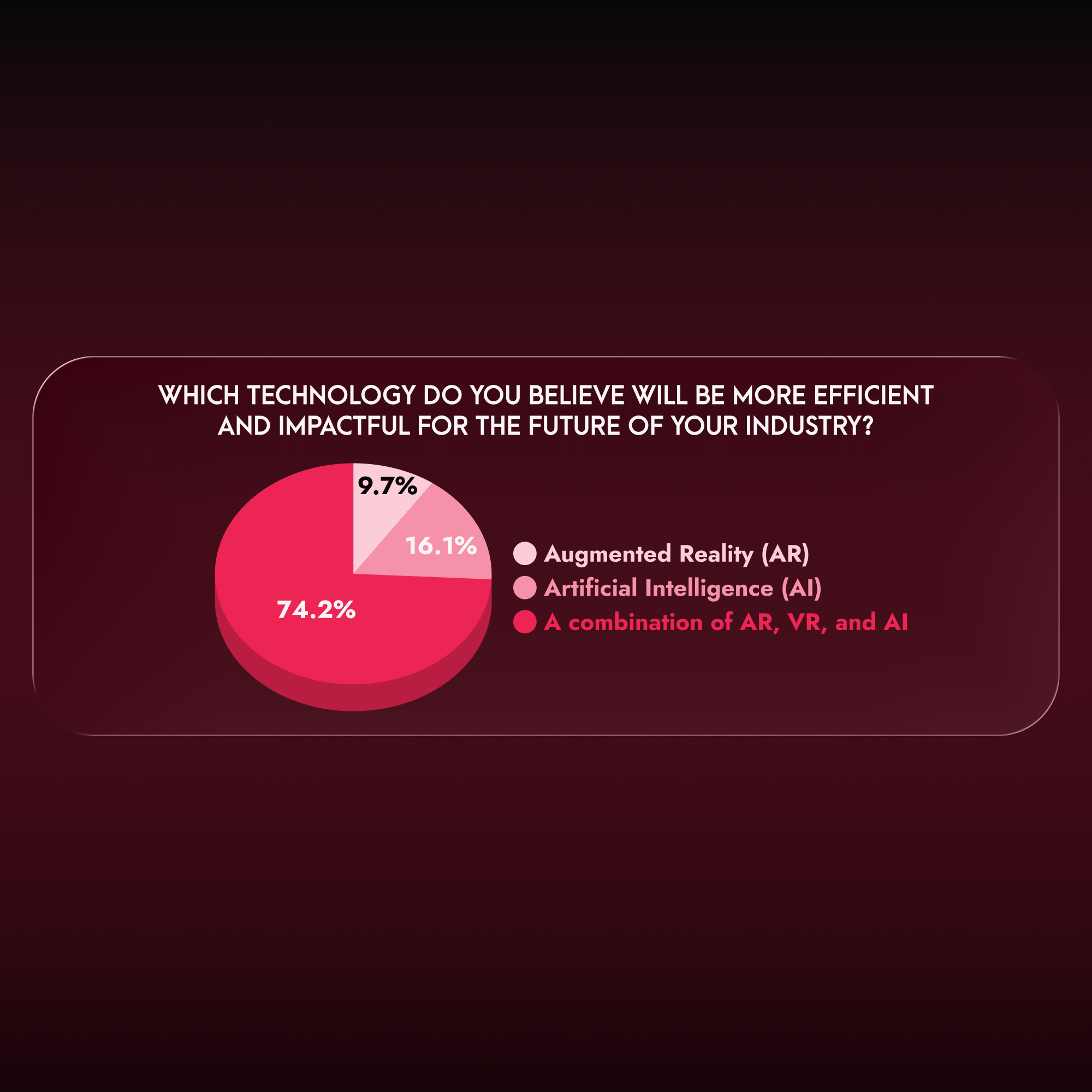
The future of XR isn’t XR alone, it’s XR + AI
XR doesn’t evolve in isolation. AI is the real accelerator.
Key insights from the research:
– 74.2% see AR + VR + AI as the most impactful tech combination
– 90.3% say AI is the main force enhancing XR
– 71% expect AR to go mainstream within 5 years
AI brings personalization, adaptive training, smart analytics, and real-time optimization into immersive experiences. Together, XR and AI turn static experiences into systems that learn, adapt, and improve over time.
Why XR matters now
As of January 2026, XR’s value is no longer theoretical.
The question is no longer if immersive technologies belong in business but how deliberately they are implemented. The data now serves as a reference point for decisions around scale, integration, and long-term return.
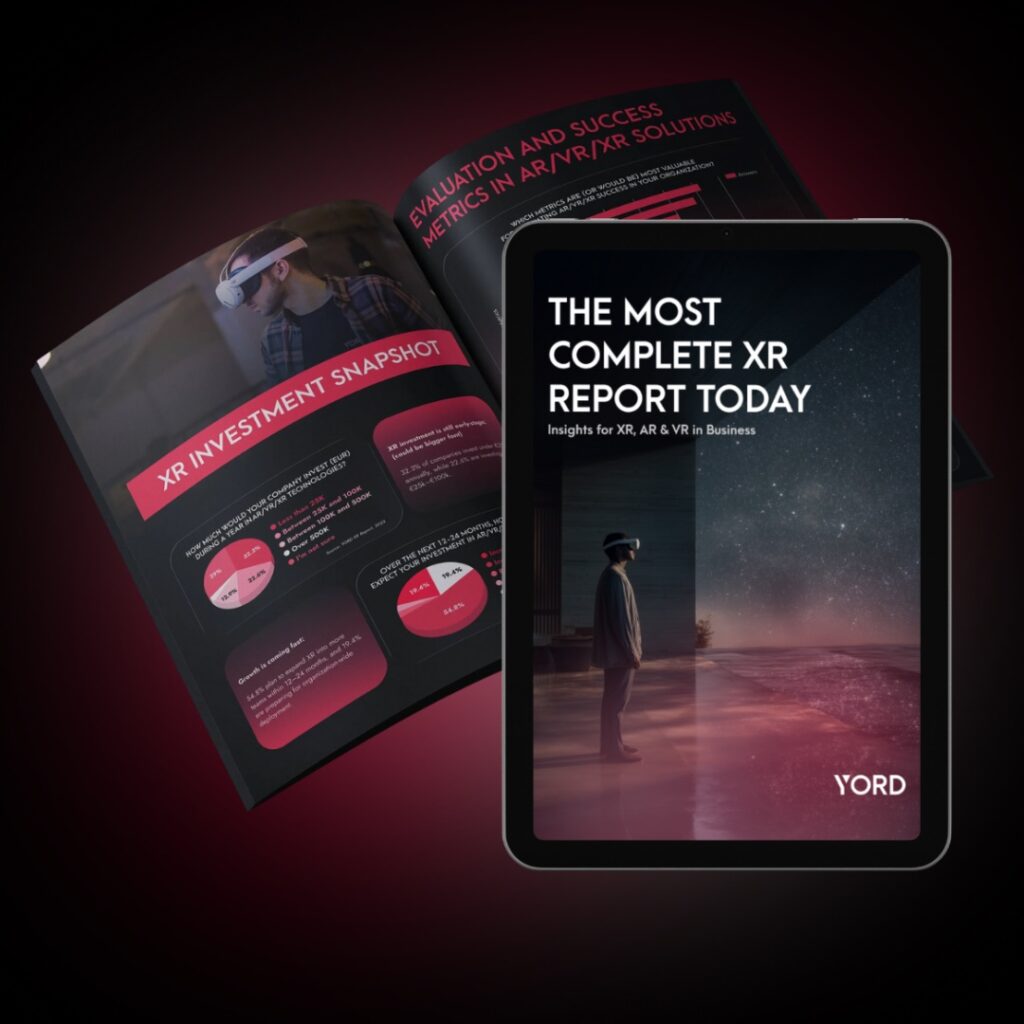
This article highlights selected insights. The full report goes deeper into the data, trends, and R&D signals shaping XR in 2026. Download YORD’s full XR Report to see where immersive technology delivers measurable value.
About YORD Studio
YORD is a top-rated global XR and AI studio, recognized by Deloitte and Clutch, with over 200 delivered XR projects for brands including Coca-Cola, LEGO, Apple, Meta, and L’Oréal. YORD helps organizations turn XR ambition into scalable, real-world solutions. In this critical market window, professional partnerships are not an added cost but the multiplier that turns investment into lasting competitive advantage.
FAQ — XR for Business
1. Is XR still experimental for businesses?
No. XR is now adopted wherever it delivers measurable ROI, particularly in training, sales enablement, and operations.
2. Which XR technology delivers ROI fastest?
AR currently leads due to accessibility, fast deployment, and mobile-first use cases.
3. Where does AI fit into XR?
AI enables personalisation, adaptive training, real-time guidance, and deep behavioural analytics inside immersive environments.
3. Which industries are adopting XR fastest?
Retail, luxury, automotive, manufacturing, healthcare, and professional training.
4. How should companies approach XR strategy today?
Treat XR as infrastructure: align it with workflows, define success metrics early, and plan for scalability.